I believe that an art guitar that is not playable is not a guitar, and therefore you have failed to create an art guitar.
So, tips: Mod Podge will NEVER dry hard enough to sand it. Since sanding down the board is a very important part of the process of keeping it playable, don't use modpodge on the soundboard.
This has been a PSA
Wednesday, April 5, 2017

Monday, March 27, 2017
Greg Details
Canvas Guitars made good guitars for like two years and then disappeared entirely, so finding info on them is hard.
This bass is fucking heavy. Not joking around. I thought it was just heavy because I was lugging it around high school when I was 17, but no, it's actually heavy.
All the hardware on this is actually really nice quality.
 The thing that drives people insane about this guitar, when they see it, is that the top wasn't done in a reversed figure, so there's this chunk where the wood grain abruptly changes.
 And it goes on to the back too.
Apart from being really heavy and a sort of awkward spot on the joining at the neck that my friend one time made fun of in 11th grade, it's a really solid guitar. It's currently got flat-wound strings on it which is sort of like playing bass on the most satisfying thing ever.
The one thing to note is that while it's a totally fine volume, this bass does not get Hella Loud like you need if you're playing screamo or something. It's a bit more of a jazzy bass than a death metal bass. It's got the full 24 frets and a deep cutout for all those fun high-fret things. Super jumbo frets make it easy to play and to hear yourself articulate.
This bass weighs about the same as my harp. It's heavy, like 11lbs or seomthing
This was the first musical instrument that tiny me saved up for and bought with my own money, so I want it to go to someone who will love it. Mostly it just needs to go to someone who will play it. I just don't do that enough anymore.
This bass is fucking heavy. Not joking around. I thought it was just heavy because I was lugging it around high school when I was 17, but no, it's actually heavy.
All the hardware on this is actually really nice quality.


Apart from being really heavy and a sort of awkward spot on the joining at the neck that my friend one time made fun of in 11th grade, it's a really solid guitar. It's currently got flat-wound strings on it which is sort of like playing bass on the most satisfying thing ever.
The one thing to note is that while it's a totally fine volume, this bass does not get Hella Loud like you need if you're playing screamo or something. It's a bit more of a jazzy bass than a death metal bass. It's got the full 24 frets and a deep cutout for all those fun high-fret things. Super jumbo frets make it easy to play and to hear yourself articulate.
This bass weighs about the same as my harp. It's heavy, like 11lbs or seomthing
This was the first musical instrument that tiny me saved up for and bought with my own money, so I want it to go to someone who will love it. Mostly it just needs to go to someone who will play it. I just don't do that enough anymore.
Hannah details
Like I said, the pink s-type usually goes for about $50ish. Some people charge extra for "patent war" models, but it's not something that makes the guitar itself better. It's just a guitar that happened to be made at the same time that Fender was suing Johnson for being too similar to the Fender patent.
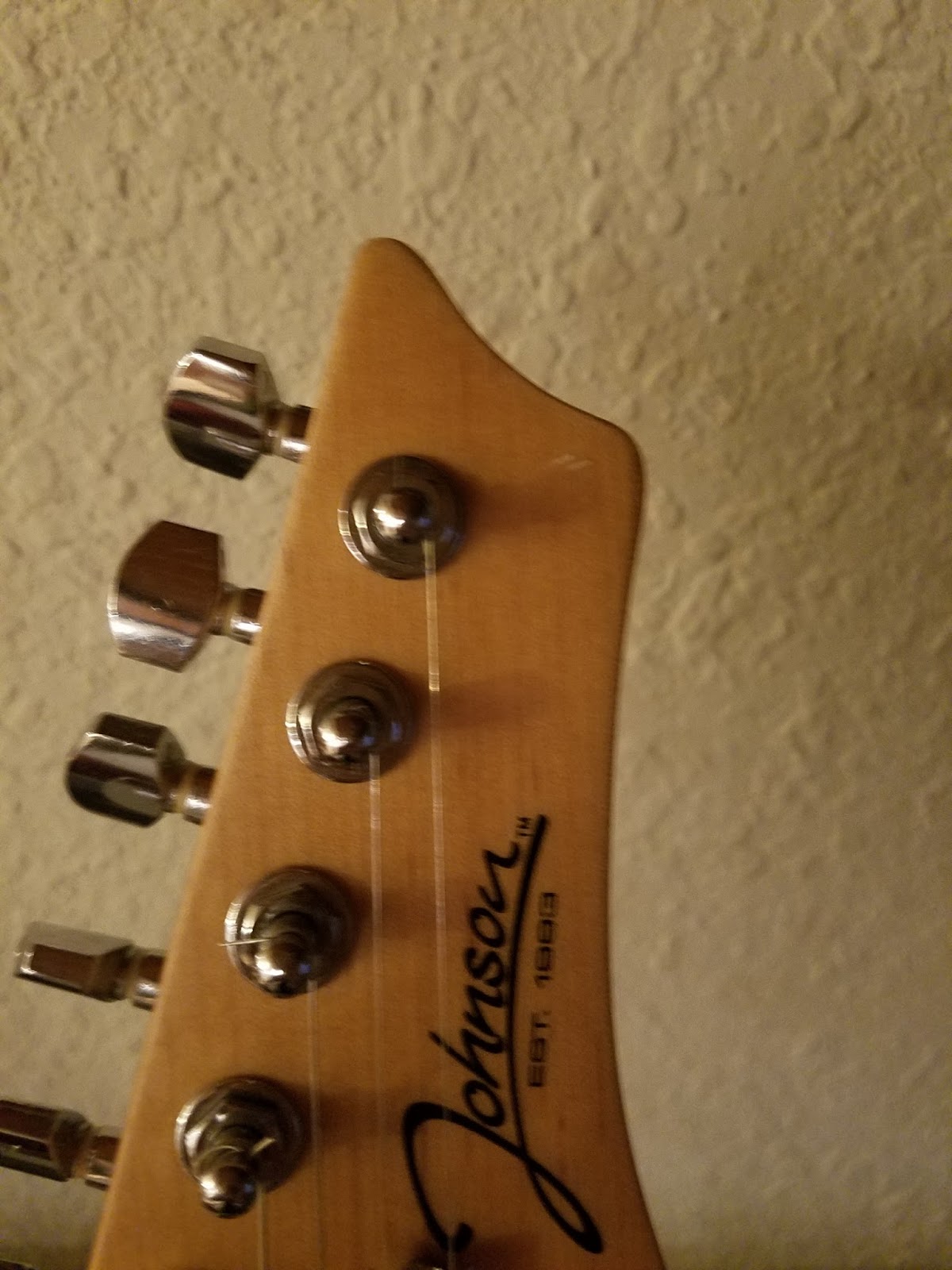
The only thing that Johnson changed after the lawsuit was the shape of the headstock.
 That chunk missing at the top is the only thing that makes this guitar a Patent War one and not a regular one. I cannot in any kind of fairness charge someone I know more for a guitar where someoneone lazily reshaped the headstock on a belt sander.
 Blue tape's there because that last fret sticks up and the high E gets stuck there while you strum. This problem can also be solved with less obtrusive tape. The butterflies and hearts come off cleanly and the neck's got the standard dot inlay underneath.
 That nut on the jack and the internal nut underneath it aren't stock. The originals fell off before I bought it, and I had to find replacements. Those replacements will not fucking fall off, made sure of it.
I don't have the trem arm or the spring that some say should go under the trem arm, but it takes stock pieces for that and last time I checked it was about $12 for the two.
 Bridge springs are in really good shape, but aren't dampened. I've never had a problem with that, but it's an easy mod.
The knobs on the front work, but they're a loose turn that "well it just doesn't feel like a fender" as a stranger once mansplained to me BECAUSE APPARENTLY I DIDN'T KNOW MY $40 BRIGHT PINK JOHNSON S-TYPE WASN'T A $1300 STRATOCASTER or something.
This is from back when Johnson used EMG pickups in their guitars instead of their shitty Johnson brand ones that are in all their guitars now.
Anyway, other than that, nothing else to disclose about it. It's a nice guitar for the quality range. Weighs nearly exactly the same as my dad's 78 Fender Strat, so just grab your nearest one of those and you'll know exactly what it feels like.
Beth's borrowed this guitar for several weeks and played it, so you can get her input if you want.
The only thing that Johnson changed after the lawsuit was the shape of the headstock.


I don't have the trem arm or the spring that some say should go under the trem arm, but it takes stock pieces for that and last time I checked it was about $12 for the two.

The knobs on the front work, but they're a loose turn that "well it just doesn't feel like a fender" as a stranger once mansplained to me BECAUSE APPARENTLY I DIDN'T KNOW MY $40 BRIGHT PINK JOHNSON S-TYPE WASN'T A $1300 STRATOCASTER or something.
This is from back when Johnson used EMG pickups in their guitars instead of their shitty Johnson brand ones that are in all their guitars now.
Anyway, other than that, nothing else to disclose about it. It's a nice guitar for the quality range. Weighs nearly exactly the same as my dad's 78 Fender Strat, so just grab your nearest one of those and you'll know exactly what it feels like.
Beth's borrowed this guitar for several weeks and played it, so you can get her input if you want.
Sunday, February 19, 2017
Bonus post: How to change a micro tank or small bowl.
I don't currently have a micro tank or a betta bowl, but I have a buttload of experience keeping betta bowls maintained (thank you, Craft Warehouse, F you, Craft Warehouse, stop selling fish. They're not craft supplies, and they're not just "product and numbers" in the words of my manager, the words that made me quit that job).
Big big big, important note: different fish have different needs. It is possible to keep a betta fish in a bowl larger than a gallon without negatively impacting their life. It is not possible to keep a goldfish in a bowl without making the fish really sick and cutting its lifespan in half. This post does not apply to any fish other than betta fish.
You're going to run into people who say you can't keep betta fish in bowls. Most of them have never tried, and they're just parroting information they hear on the internet. I, personally, get more enjoyment out of watching fish who have swimming space and a low-stress life, so I keep my fish in larger tanks. However, if you've decided that you want to keep a fish in a bowl, I think it's important to have some useful and correct information out there.
The first thing I want to say, though, is that I have maintained a lot of fish in a lot of fish in bowls ranging from .5 to 2.5 gallons, and I do not think it is possible to meet a betta fish's survival needs in a bowl or tank smaller than one gallon. The difference in fish health between living in 1.5 gallons versus living in 0.75 gallons is easily visible.
If you've already got a 0.25 gallon betta cube and you want to keep something in it, look into planaria, the only pet you can cut in half to make two of them. Other great pets for a betta cube include m&m's and plastic dinosaurs.
I'm going to be kind of harsh here. In a bigger tank, you get a little more flexibility with what you want to do, and you get a little more flexibility with how you want to care for it. When you've moved your fish down to the smallest container possible for it to stay alive, you need to be ready to provide everything you need to keep it alive.
First, if you're doing a betta bowl or a micro tank (tank under 2.5-3 gallons), you need certain things when you set it up:
So, you've got your bowl set up? Good. Now, it's time to clean it.
And there you go. Sorry for no pictures, but I'm not at a point in my life right now where my lifestyle gives me enough free time to maintain a high-maintenance thing like a micro tank, so I couldn't take any.
Take care of your fish, and they'll make you happy.
😃
Big big big, important note: different fish have different needs. It is possible to keep a betta fish in a bowl larger than a gallon without negatively impacting their life. It is not possible to keep a goldfish in a bowl without making the fish really sick and cutting its lifespan in half. This post does not apply to any fish other than betta fish.
You're going to run into people who say you can't keep betta fish in bowls. Most of them have never tried, and they're just parroting information they hear on the internet. I, personally, get more enjoyment out of watching fish who have swimming space and a low-stress life, so I keep my fish in larger tanks. However, if you've decided that you want to keep a fish in a bowl, I think it's important to have some useful and correct information out there.
The first thing I want to say, though, is that I have maintained a lot of fish in a lot of fish in bowls ranging from .5 to 2.5 gallons, and I do not think it is possible to meet a betta fish's survival needs in a bowl or tank smaller than one gallon. The difference in fish health between living in 1.5 gallons versus living in 0.75 gallons is easily visible.
If you've already got a 0.25 gallon betta cube and you want to keep something in it, look into planaria, the only pet you can cut in half to make two of them. Other great pets for a betta cube include m&m's and plastic dinosaurs.
I'm going to be kind of harsh here. In a bigger tank, you get a little more flexibility with what you want to do, and you get a little more flexibility with how you want to care for it. When you've moved your fish down to the smallest container possible for it to stay alive, you need to be ready to provide everything you need to keep it alive.
First, if you're doing a betta bowl or a micro tank (tank under 2.5-3 gallons), you need certain things when you set it up:
- A bowl that is as big as you can physically pick up and move around when it's full. It needs to hold a gallon or larger, or it's too small for the fish. If it's too heavy for you to move, you're never going to clean it on a regular schedule. If you can't find a bowl that's over a gallon, but light enough for you to move, either get a lighter bowl and a lighter decor, or get a 5-gallon and a filter. I cannot stress enough that it is actually much easier to maintain a 5-gallon tank than it is to maintain a small bowl. Less stress on you, less stress on your fish.
- A heater that you trust. Before you buy a heater, look up reviews of it. There's some heaters marketed especially for bowls that overheat and kill fish. The less water you have, the more quickly an overheat will kill someone. The basic rule is the less water you have, the less room you have for things to go wrong. Your heater needs to keep the tank at roughly 78 degrees. A small bowl or tank is going to be colder than the room temperature, and very likely to get too cold if you turn the heating off or the air conditioner on. You can't let your room regulate your temperature. You need to heat it yourself.
- NO FILTER. That's right. Unless it's three gallons or larger, no filter. Look back to #2 and read that bold text again. Betta fish have an adaptation that allows them to live in a higher ammonia environment than most other fish. They don't have that same resistance to nitrite. Nitrite is also, on its own, more toxic than ammonia. If you don't have enough water in your tank, your cycle will crash, and it will make nitrite. Among the many things that a filter does, it makes it easier for you to take care of a mini ecosystem in your tank. If you want a micro tank or a betta bowl, you need to be ready to change the water once or twice a week. Once again, a bowl is harder to maintain than a 3-5 gallon tank.
- Easy to remove, easy to clean substrate. The poop goes into the gravel, and you're going to have to get it out. My favorite substrate for a bowl is glass rocks or marbles. You want the ones that are the diameter of a quarter, or smaller. If you want big rocks, you need small rocks to fill in the gaps, because for some reason betta really like to get stuck under rocks. They like getting stuck. They don't really like the subsequent death. Whatever rocks you use, you need to be able to take them all the way out and wash them off, and wash the bowl out. You can use gravel and a strainer, if you want. You can also have just a bare bottom of your tank. That's all up to you, but you need to be able to remove all of your substrate and wash it. Sand is really bad for betta bowls.
- Enough places for your betta to hide. Being in a small, clear bowl does not make your fish feel any less exposed than being in a large, empty tank. Betta need some form of cover, or they get stressed out and more vulnerable to sickness. You need a cave they can't get stuck in Flower pots that are unglazed or glazed with non-metallic high-fire glaze work well if you lay them on their sides. Plants that can't scratch them and that won't rot in the water are a good thing, too. I like weighted silk plants.
- Nothing else polluting their water. Live plants are pretty, but live plants in a bowl do not filter the bowl. Live plants in your betta bowl may make the conditions in the bowl much worse. Plants do not filter your water. PLANTS DO NOT FILTER YOUR WATER. Lucky bamboo and peace lilies are both land plants, and they need to have their leaves exposed to the air. All live plants can have parts that die, break off, and rot. When you clean your bowl or microtank, you're going to take everything that's in it, out. This can stress out the plant and make roots break off, or just make your plant die. Dead plant bits are just adding to the shit you have to clean out of the tank.
- Food and respiration space. Betta fish need to take gulps of air from the surface of their water. It feeds their labyrinth organ, which is sort of like a lung. This is the adaptation that helps them live in higher ammonia environments than some other fish. If they can't get air from the surface, they die. The surface of their water needs to be mostly clear, with space to allow oxygen to reach the surface. This means that, while pretty, putting a peace lily on top of a betta bowl is a bad idea. Also, betta fish don't live off the roots of the peace lilies in the plants. They're carnivores. If you've seen a betta in a peace-lily-on-top setup biting at the roots, it's usually because it's starving to death and willing to try anything. A betta's body is unable to eat and get nutrients from plant roots in the same way our body isn't able to eat and get nutrients from plastic soda bottles. You need to give your fish actual food made from actual meat.
So, you've got your bowl set up? Good. Now, it's time to clean it.
- Grab your ammonia test kit (YOU NEED AN AMMONIA TEST KIT. It really doesn't matter if it's expensive and you don't want to spend that much money. Trying to maintain a bowl without owning an ammonia test kit, "because it's expensive," is like trying to store food in a refrigerator that isn't plugged in "because electricy costs a lot." Someone's going to get sick because of what you're doing and they're going to die). Do a test on your water. If your ammonia is above .5ppm, you know that it's been too long since your last water change. You need to do a water change when your ammonia goes above 0.5 OR when you see crap accumulating on the bottom OR once a week, whichever comes first. After a while of testing, you're going to have a good idea of when you need to change your water, but you should still do a test before each change. As your fish grows up, gets healthier, gets sicker, water gets warmer, water gets cooler, the ammonia production will change.
A good rule to go by: If you tested your water and it was 1ppm, and you haven't done a change for 12 days, you should change your water and check it again in 6 days. If you test your water 6 days later and your ammonia is below 0.5ppm, you need to do your next change in 6-7 days. Your ammonia test will give you an exact answer for the question of how many days should you go between changes. - Cup your fish. You can use the cup you got him in, or any other clean cup that you save for that purpose. Get him out of the bowl and put him somewhere where you can keep an eye on him, won't knock him over, and where the cat won't see him.
- Unplug your heater. You can let it cool for about half an hour, or grab another cup full of water and stick the heater in that to cool off while you clean the bowl.
- Take the whole bowl to the sink of your choice. Scoop out some water first, if you need to. You can also use the bathtub if you don't like using a food sink. You can use your garden hose outside if you don't like using your bathtub.
- Pull out your castles and plants and other things and set them aside.
- Use a bucket or a large bowl or a colander that you use only for fish, and pull all your substrate out. Try to get as much rocks and as little water as you can. Dump the rest of the water out of the bowl.
- Do not use soap on anything at all. No soap. Don't even wash your hands with soap until you've finished the whole change and made sure your fish buddy's okay.
- Rinse out the bowl. Using a paper towel or your hand, wipe the inside of the bowl to get any extra gunk out, and then rinse it again.
- Rinse off the rocks and all your decoration. Grab your now-cooled heater and rinse that off as well.
- Fill the bowl halfway with water that's roughly the same temperature as the temperature in the cup your fish is in. If your heater goes under your rocks, put it in place. Don't just dump all the rocks into an empty glass bowl, or you can break it. You can do it a handful at a time, or fill up the bowl some of the way before dumping the rocks in.
- Either decorate the bowl the way you usually do, or take the bowl to where it lives, and then decorate it.
- Fill the bowl up all the way. Match the temperature of the water to the temperature of the cup your fish is in. Put conditioner into your water. (I like to fill the bowl with tap water, and then put the conditioner in. I like to pretend that the chlorine in the water kills some of the remaining bacteria in the bowl. I objectively know it doesn't, but it makes me feel good and it doesn't hurt anything)
- Put your fingers over the top of his cup like a screen, and dump all the water out of the cup without dumping the fish out. Immediately dump the fish into the bowl. This makes sure that you don't add high-ammonia water back into the bowl.
- Look at your fish and tell him he's pretty. Watch for a couple minutes to make sure he's breathing okay. If his breathing is very labored and doesn't settle down after two minutes, take him out and figure out how a toxin could get into his water. Change all the water again.
And there you go. Sorry for no pictures, but I'm not at a point in my life right now where my lifestyle gives me enough free time to maintain a high-maintenance thing like a micro tank, so I couldn't take any.
Take care of your fish, and they'll make you happy.
😃
A tale of three betta water changes, #1, when it's all right
I did the legendary Triple Water Change Extravaganza today, and all three tanks that I have ended up being very different. Since I know some folks have questions about when do I have to water change, why do I have to water change, how much do I have to water change, and all the rest, time for not one, not two, but three blog posts about changing water.
Those of you who don't keep up with my many betta fish (HOW DARE YOU) might not remember little Cinco, the fish who can't swim (and also isn't all that small).
Cinco is in a 5 gallon tank with a highly restricted sponge filter. He has a submersible, adjustable, 25w glass heater.
So, first question: Why do I have to water change?

Your water tests tell you how much water you need to change.
(If the cycle's going really well, there shouldn't be an ammonia reading at all. The fact that there was ammonia means that I need to move the filter up a notch to get more water going through it)
Even if your water tests are below maximum, if it's water change day, it's a good idea to change enough of the water to vacuum your gravel. Poop falls in there and you don't want him living in poop, bro.
While you're doing those water tests, unplug your heater and filter. Changes are easier if you turn those off.
 (Say hi to my mom, accidentally photobombing the tank here.)
After your water tests, take some time to look at your fish. Really look at him. You need to know what your fish looks like, so that you can notice if anything changes. Keep an eye on things that concern you.
If your fish gets sick, it's important to know if that shiny spot on their back is a tumor they've already had or a rapidly-developed columnaris saddle. Fish that are sick usually are sick before they start acting sick. The key to keeping your fish healthy is to notice that they are looking or acting differently before they start looking or acting sick. My fish Casper had a tumor on his back that grew slowly, but ended up the size of an edamame bean. Keeping an eye on him, how it was growing, and how it was acting, let me know when it was starting to affect his quality of life.
Also, if I saw another fish lie on the bottom or lie flat on decorations like Cinco does, I would immediately think that they were sick. Because I know Cinco, however, and I keep a close eye on all his traits and behaviors, I can use other things to judge if he's feeling sick.
If you're new to betta fish or if you like lists, you can keep a journal for your fish. Every time you change the water, you can write down temp, test results, what size water change you did, and the state of the fish's eyes, fins, body, movement, breathing, and iridescence. This is handy to look back on when you think something isn't right.
Step two of the water change is to take water out of the tank and put it in a bucket. If your tank isn't small enough for you to safely pick up and move to a sink, look into getting a siphon.
Quick note: Even if you let your filter and heater cool, try to keep the heating element under water. If you put your heater horizontally near the bottom of the tank, you can drain almost all the water out without it reaching the air.
Siphons use gravity to suck the water out of the tank. While they're sucking the water out, they can also suck crap out of your gravel.
To vacuum all of the gravel, I ended up draining about half the water. If I had a smaller siphon, I could do it in less, but I only want to own one siphon. This is the medium size.
You can use the siphon to vacuum pea-sized gravel and small glass stones by just shoving it into the gravel to suck some of it up into the siphon, and then picking it up to let the gravel out. It lets the gravel down but keeps the fish poopies in your bucket. You just repeat that process until you've vac'd all the gravel.
If your tank is bare, or has sand, you can just hover it over the bottom and it'll pick it up. Some people argue that this makes bare tanks or sand tanks safer, but I disagree. That's for a later post.
Step three of your water change is to use the water in your bucket to water your household plants. The water from your water change has an elevated nitrate level. Nitrate's good for plants. You don't have to waste water. The sea pig gets a fish in its butt. Everyone wins.
Once that's done, dump the rest of the water and fill the bucket up with new water.
 Make sure it's within a few degrees of the temperature of your old water. Pull your thermometer out of the tank and use it to check, if you need to.
All the water in betta fish range should feel slightly warm when you feet it with your fingertips, and slightly cool when you feel it with the inside of your wrist.
You're going to need to put water conditioner into your water, to remove chlorine, chloramine, and heavy metals (unless you're awesome, like me, and get all of your water from your private well and control every aspect of it and are 100% sure it has nothing in it).
My favorite water conditioner is Seachem Prime. It's pretty intensely concentrated, so you only need two drops per gallon to remove chlorine and its friends.
Prime's also handy for if your cycle crashes, but you can't do a change right then, because it temporarily detoxifies ammonia and nitrite. Just follow the directions on the bottle.
However, almost all water conditioners have nearly the same ingredients. Anything that says, "removes chlorine, chloramine, and detoxifies heavy metals," will do the job. I have never run into a water conditioner that doesn't work.
Water conditioner is slightly different from dechlorinator. Dechlorineator removes chlorine, but not chloramine or heavy metals. Most municipalities use chloramine instead of chlorine, so dechlorinator doesn't do all that much.
You hear stories of leaving the water to sit overnight and the chlorine evaporates. This is. Well. Uh. If we were in like 1970, yes? If you leave the water out for about a week, the chlorine evaporates. The chloramine doesn't. The heavy metals don't. It takes a long time. Aquasafe is $2 a bottle. Just get some.
Water conditioner works almost instantly. Drip it in the bucket, give it a stir or let it sit for a few seconds, and you're good. If you're adding water conditioner to the bucket, dose enough for the number of gallons in the bucket. If you're adding to the tank before you add your water, dose enough for the whole capacity of the tank.
If I had a 20-gallon tank and I was adding 5 gallons of water, I'd add 5 gallons worth of conditioner to the bucket, or 20 gallons of conditioner to the tank.
It's safe to go a little bit over on water conditioner. An extra few drops won't hurt the fish, though it also won't make the tank any better.
 So, now you need to get the water from your bucket, into your tank. I am not a super strong lady, and a lot of the time I can only barely lug 5 gallons of water around the house. I used to have a pitcher for scooping the water up, but it was too small and I got tired of it. Now I use a milk jug that I sawed the top off with a steak knife. It was easy, and fun!
Any time you use something for your fish, before you use it the first time you need to wash it extremely carefully in hot water, with no soap, and a lot of abrasion. You don't want to dump milk into your tank. My milk pitcher lives in my fish bucket with my water change towel. I use the towel to cover the space between my bucket and the tank, to catch drips.
After a couple of scoops into the tank, I can usually pick up the bucket and dump it in. When you dump, be careful to not dump on the fish. It scares the poor boys.
Cinco already can't swim, so pushing him around with water really upsets him and might hurt him.
I usually aim all my pours on the top of a decoration. If it hits the top of a cave instead of the gravel, it disperses the water and gravel doesn't go flying everywhere. This is especially handy if you're using sand instead of gravel.
Then it's just a quick rearranging of the decorations that might have gotten knocked out of place during the process, and a check on the fish, and you're done! Just time to put everything away.
And there you go, how to do a water change when there's nothing wrong with the tank.
Just remember, test the water, look at the fish, then change the water. Easy, easy.
Those of you who don't keep up with my many betta fish (HOW DARE YOU) might not remember little Cinco, the fish who can't swim (and also isn't all that small).
Cinco is in a 5 gallon tank with a highly restricted sponge filter. He has a submersible, adjustable, 25w glass heater.
So, first question: Why do I have to water change?
- If your tank has a filter, your water change is largely to remove nitrate generated by your nitrogen cycle
- If your bowl does not have a filter, your water change is to remove ammonia generated by your fish
- You also remove solid wastes from the water while you change the water
- If your cycle failed, you need to do a water change to remove other toxins that build up
- If something bad gets into your tank (toxin, disease, or other), you might need to do an emergency 100% water change with cleaning. This is different from today's water changes.
- When you need to change the water is determined by a lot of things. Some tanks need it once every two weeks or once every week. A small 1-gallon bowl or a tank with a broken/forming nitrogen cycle may need it twice a week.
- I can't tell you exactly when you need to do water changes. On the other hand, you can buy a thing that can tell you exactly when you need to do water changes. Go out and get yourself an accurate test kit for freshwater. I like API's liquid tests. They're easy to do and easy to read, and have a reputation for being accurate.
- If you have fish, you need a test kit. This is important. Trying to take care of a fish without a test kit is like trying to drive your car if you have 3" of snow on all your windows. You can't tell what you're doing, and you're going to kill someone because of it.
- If you have a tank with a filter, you need a test for ammonia, a test for nitrite, and a test for nitrate. If your tank does not have a filter, you only need a test for ammonia. Your bowl won't produce any nitrite or nitrate.
The first thing you're going to need to do is to run a water test. This is the first step of doing the water change. Without this, you can't tell if you had a surprise spike in the system, and you might change too little water. Living in fucked up water makes your fish weaker, which means if they get sick, they're going to die of a disease a healthy fish could fight off.
For some reason, I don't have a picture of all three tests, but his nitrite was zero, ammonia was below .25ppm, and nitrate at about 20


Your water tests tell you how much water you need to change.
- If your ammonia is above .25, you need to do a change big enough to get it under .25
- If your nitrates are above 20, you need to do a change big enough to get it at 20 or below
- If your nitrite is anything, you need to get that level down to where it doesn't register on your test at all. This is usually 80%-100% of the water.
(If the cycle's going really well, there shouldn't be an ammonia reading at all. The fact that there was ammonia means that I need to move the filter up a notch to get more water going through it)
Even if your water tests are below maximum, if it's water change day, it's a good idea to change enough of the water to vacuum your gravel. Poop falls in there and you don't want him living in poop, bro.
While you're doing those water tests, unplug your heater and filter. Changes are easier if you turn those off.
 (Say hi to my mom, accidentally photobombing the tank here.)
 After your water tests, take some time to look at your fish. Really look at him. You need to know what your fish looks like, so that you can notice if anything changes. Keep an eye on things that concern you.
If your fish gets sick, it's important to know if that shiny spot on their back is a tumor they've already had or a rapidly-developed columnaris saddle. Fish that are sick usually are sick before they start acting sick. The key to keeping your fish healthy is to notice that they are looking or acting differently before they start looking or acting sick. My fish Casper had a tumor on his back that grew slowly, but ended up the size of an edamame bean. Keeping an eye on him, how it was growing, and how it was acting, let me know when it was starting to affect his quality of life.
Also, if I saw another fish lie on the bottom or lie flat on decorations like Cinco does, I would immediately think that they were sick. Because I know Cinco, however, and I keep a close eye on all his traits and behaviors, I can use other things to judge if he's feeling sick.
If you're new to betta fish or if you like lists, you can keep a journal for your fish. Every time you change the water, you can write down temp, test results, what size water change you did, and the state of the fish's eyes, fins, body, movement, breathing, and iridescence. This is handy to look back on when you think something isn't right.
Step two of the water change is to take water out of the tank and put it in a bucket. If your tank isn't small enough for you to safely pick up and move to a sink, look into getting a siphon.
Quick note: Even if you let your filter and heater cool, try to keep the heating element under water. If you put your heater horizontally near the bottom of the tank, you can drain almost all the water out without it reaching the air.
Siphons use gravity to suck the water out of the tank. While they're sucking the water out, they can also suck crap out of your gravel.
To vacuum all of the gravel, I ended up draining about half the water. If I had a smaller siphon, I could do it in less, but I only want to own one siphon. This is the medium size.
You can use the siphon to vacuum pea-sized gravel and small glass stones by just shoving it into the gravel to suck some of it up into the siphon, and then picking it up to let the gravel out. It lets the gravel down but keeps the fish poopies in your bucket. You just repeat that process until you've vac'd all the gravel.
If your tank is bare, or has sand, you can just hover it over the bottom and it'll pick it up. Some people argue that this makes bare tanks or sand tanks safer, but I disagree. That's for a later post.
Step three of your water change is to use the water in your bucket to water your household plants. The water from your water change has an elevated nitrate level. Nitrate's good for plants. You don't have to waste water. The sea pig gets a fish in its butt. Everyone wins.
Once that's done, dump the rest of the water and fill the bucket up with new water.

All the water in betta fish range should feel slightly warm when you feet it with your fingertips, and slightly cool when you feel it with the inside of your wrist.
You're going to need to put water conditioner into your water, to remove chlorine, chloramine, and heavy metals (unless you're awesome, like me, and get all of your water from your private well and control every aspect of it and are 100% sure it has nothing in it).
My favorite water conditioner is Seachem Prime. It's pretty intensely concentrated, so you only need two drops per gallon to remove chlorine and its friends.
Prime's also handy for if your cycle crashes, but you can't do a change right then, because it temporarily detoxifies ammonia and nitrite. Just follow the directions on the bottle.
However, almost all water conditioners have nearly the same ingredients. Anything that says, "removes chlorine, chloramine, and detoxifies heavy metals," will do the job. I have never run into a water conditioner that doesn't work.
Water conditioner is slightly different from dechlorinator. Dechlorineator removes chlorine, but not chloramine or heavy metals. Most municipalities use chloramine instead of chlorine, so dechlorinator doesn't do all that much.
You hear stories of leaving the water to sit overnight and the chlorine evaporates. This is. Well. Uh. If we were in like 1970, yes? If you leave the water out for about a week, the chlorine evaporates. The chloramine doesn't. The heavy metals don't. It takes a long time. Aquasafe is $2 a bottle. Just get some.
Water conditioner works almost instantly. Drip it in the bucket, give it a stir or let it sit for a few seconds, and you're good. If you're adding water conditioner to the bucket, dose enough for the number of gallons in the bucket. If you're adding to the tank before you add your water, dose enough for the whole capacity of the tank.
If I had a 20-gallon tank and I was adding 5 gallons of water, I'd add 5 gallons worth of conditioner to the bucket, or 20 gallons of conditioner to the tank.
It's safe to go a little bit over on water conditioner. An extra few drops won't hurt the fish, though it also won't make the tank any better.
 So, now you need to get the water from your bucket, into your tank. I am not a super strong lady, and a lot of the time I can only barely lug 5 gallons of water around the house. I used to have a pitcher for scooping the water up, but it was too small and I got tired of it. Now I use a milk jug that I sawed the top off with a steak knife. It was easy, and fun!
Any time you use something for your fish, before you use it the first time you need to wash it extremely carefully in hot water, with no soap, and a lot of abrasion. You don't want to dump milk into your tank. My milk pitcher lives in my fish bucket with my water change towel. I use the towel to cover the space between my bucket and the tank, to catch drips.
After a couple of scoops into the tank, I can usually pick up the bucket and dump it in. When you dump, be careful to not dump on the fish. It scares the poor boys.
Cinco already can't swim, so pushing him around with water really upsets him and might hurt him.
I usually aim all my pours on the top of a decoration. If it hits the top of a cave instead of the gravel, it disperses the water and gravel doesn't go flying everywhere. This is especially handy if you're using sand instead of gravel.
Then it's just a quick rearranging of the decorations that might have gotten knocked out of place during the process, and a check on the fish, and you're done! Just time to put everything away.
And there you go, how to do a water change when there's nothing wrong with the tank.
Just remember, test the water, look at the fish, then change the water. Easy, easy.
Thursday, October 27, 2016
the blue Amazon GSO, review part 1
The extras include a tuner that is a pitch pipe that doesn't play the right notes, a strap that actually works like a strap, strings that you can't put on the guitar or you'll break it, a "gig bag" that's tissue paper thin, and a pick that's 2.5" long, no joke.
The Guitar Shaped Object checklist
"Guitar Shaped Object," is a term used to describe an item that was sold as a guitar, but lacks some of the important features that makes a guitar playable.
In the realm of people who buy cheap guitars, accusing someone's instrument (or 'instrument') of being a GSO is asking for a fight. You get a lot of, "well, it works well enough," and "it's all I can afford! Do you want me to not play at all?!" and "not everyone can afford a $3,000 guitar!"
However, and I'm just going to say it, if you spent money on s guitar-shaped object and not on a real guitar, then you don't own a guitar. Spending money on a guitar you can't play and calling it a guitar is as bad of a financial choice as spending money on a spiral-bound notebook and calling it an iPad. You spent less, but you're not going to get the experience of playing a guitar out of it.
Most people who fall victim to guitar-shaped objects are people who don't have experience with quality instruments. If you've played a $500 guitar, then broken tuners will feel broken. Bad action will feel bad. Stressed joints will look stressed. If you haven't really played any guitar except for your GSO, you're more likely to think that the broken parts are normal or "good enough." Sometimes they are good enough. Sometimes they're actively stopping you from learning. If you have no other frame of reference, then you can't know which is which.
When someone's critical of your much-beloved Object, it's easy to want to write them off as, "Well, they play $3,000 guitars all the time, so they don't know what a cheap guitar is like."
However, it's important to remember that people who play $3,000 guitars do know what guitars in general are like. Most people who own a $3,000 guitar also owned a $200 guitar at some point in their lives. When a person with a $3,000 guitar says that your GSO is impossible to tune, they aren't saying, "Well, it doesn't have GForce and tune itself!" They're usually saying, "The tuners are moving when they should stay still and are not moving when they should," or "The nut is badly cut and is holding onto the string, making my tuning less accurate."
I've been trying to make an objective checklist for determining if your object is a GSO or a real guitar, and it's been a bitch to make, but here's what I've got so far:
Please note that this list is made with 'guitars' sold in a new state. Your great-grandfather's guitar that requires a lot of care and precision to sound good is not a GSO, it's a guitar in retirement. An instrument that was great new, but slowly lost elements of functionality, is very different from an instrument that, when new, never had those elements.
The number one, defining thing:
Can a person who has good technique make it sound good, using good technique?
This video of the Barbie Violin is a good example. She clearly knows how to play, and this is what it sounds like:
Here's why this matters:
Guitar technique is universal. While there's some difference between guitars of different styles and music of different styles, a person with basic good technique should be able to pick up a guitar and have it make some pleasing sounds.
That's what I love about the Barbie violin video: in the second half of the video, she switches to a very basic song that is taught to people just learning the instrument, and it sounds like a screaming mess.
If your guitar requires bad technique to make it sound passable, it's not a guitar, it's a GSO. If a guitar requires extremely precise technique to make it sound passable, it's not a good instrument for a beginner, but it might not be a full GSO.
Do the pieces work as intended?
Not talking about the fine things here. This isn't asking if the tuners are smooth or the balance is perfect. Can you use the tuners to get the strings in tune? Do the frets change the pitch of the strings?
No? Then it's a GSO.
And then the finer things. Do the tuners turn in the normal direction? Can the strings be wound on the tuners in the normal way, or are they fiddly or backwards? Do the frets buzz? Does the output jack give clear output from every angle, or does it cut out if the cord's held at certain directions? Do the tone controls give you a wide range of tones? or just one or two spots where it sounds good and the rest is a mess? One or two of these things alone might not make it a GSO, but several definitely pulls it in that direction.
Why this matters:
The function of the basic pieces of a guitar is not a feature, it's an element. If you buy a car where turning the wheel left goes right and turning it right makes the car go left, it's not a funky quirky car. It's just a shitty car. A guitar that requires a Master's degree in precise string winding and fiddly tuning isn't a guitar, it's an Object.
If it doesn't properly fulfill the basics of what it takes to be a guitar, it's not a guitar.
Are all the pieces there?
Does it seem like all guitars have a function that yours doesn't have? That might be because you don't have a guitar, you have an Object.
Fully electric guitar, but no tone controls? Doesn't have a truss rod, but every other guitar you can find like it does? No way to adjust the intonation or action at the bridge? Does it have a head design that needs string trees, and that plays like it needs string trees, but it doesn't have string trees?
I'm not talking about an acoustic guitar not having a scratch plate or a strap button at the top. I'm talking about an essential elements that make a good sound. To go back to the car metaphor, it's still a car if it doesn't have air conditioning. It's not a car if it doesn't have seats or a break pedal.
Why this matters:
It might be able to make good noise without the essential pieces, at least for a while. But a good guitar has elements that make it playable in a wide variety of situations, and has pieces that can adjust for changes in humidity or different kinds of amps or different thicknesses of strings.
Not having elements that do that might not stop it from being a guitar, but only in the same way that my 1989 VW Rabbit that hasn't driven since '02 is a car. It's a car, but only if it stays in one location and does very specific things. If you can't use it like a guitar, it's not a guitar.
Does it play the right notes?
People own guitars for two reasons: to make music and to get laid. If your guitar will not make music, you will not get laid. Therefore, guitars exist for one reason: music.
If your guitar does not play the right notes, you will not make music, and therefore not get laid. ):
Guitars play the wrong notes for three main reasons: the strings are out of tune, the intonation is wrong, or the fretboard is wrong.
If the string is the wrong tune, the string itself should still play properly relative to itself. When you play the first fret, the note should be raised half a step, no matter what the string is set to.
If the intonation is wrong, you can hopefully fix that (see previous comment about adjustable bridge saddles).
If the frets are in the wrong place, you're fucked. There are two ways to fix a guitar with frets in the wrong place. The first is the extremely expensive fretboard replacement, where a new board is made with the right frets, and put on your guitar.
The second is the more common, frequently similarly-priced, full-guitar replacement.
This is an easy thing to check for yourself. You need a precise tuner (I use GStrings on my phone) that tells you the HZ of each note, and you need your guitar (with suitable amplification to make the tuner pick up your notes).
So, pick a string, and tune it with the tuner so that the open string plays a note perfectly. That little needle should be right in the center of the tuner display.
Now fret the first fret and play the string again. You want that note to be almost in the center of the display as well. Check around on the fretboard, and you want most frets to be playing notes that have the needle roughly in the center. If your frets are ringing really sharp before about the 5th fret, you're going have problems.
Why this matters:
If it can't play music, it's not a guitar, it's a GSO.
How long is it going to last?
Durability is not always the sign of a good guitar. Unnecessary fragility is frequently the sign of a bad guitar.
Guitars go through things. You love them, you treat them nice, you buy fancy hard cases that protect it from harm, but it's also going to be in your car when you get into a crash and strapped to your shoulder when a drunk guy rams the stage with his shoulder.
Three of my guitars and two of my ukuleles are 10+ years older than me, and still in totally playable shape. None of these guitars was built to be particularly durable, and all of them have a little bit of road wear and battle damage, but none of them have broken in a way to make it unusable or less enjoyable to play.
Every guitar that I own could survive a drop from 9" high onto a wooden floor and not suffer any structural damage (yes, even the 30-year-old Ovation, despite everyone's insistence that it'll shatter like glass). I'm not saying you need to beat your guitar up, but if you're afraid to grab it by the neck and pick it up, it better have a really good excuse for being that fragile.
And another thing: A guitar shouldn't destroy itself through the process of existing. If you tune it up, put it on a good stand, leave for the weekend, and come back to a neck that's broken and unglued itself, you didn't have a guitar.
They're not like violin bows. You don't need to remove the tension when they're not in use.
Why this is important:
Because even if it was a guitar before you dropped it, if it broke in the first week of you owning it, it's now a guitar-shaped object.
OKAY, PINK, BUT WHY DO YOU CARE? why do YOU care how I spend MY money?
1) Because I like playing the guitar and watching other people get excited about learning the guitar. Because there's something very special to me about watching someone get interested in a thing I am interested in. Because I think the worst thing you can do to someone who is interested in something is to make it so they are not interested in that thing anymore. Because giving someone who wants to learn guitar an Object doesn't just make them lose interest in that particular Object, but in playing guitar in general.
2) Because there are so many good quality instruments out there that cost the same or less than the GSO crap you bought off Amazon for $39. This is especially true with guitars. There's so many people out there who bought a usable guitar, found out it wasn't for them, and are selling it in barely-used condition.
There are three ways to judge if you got your money's worth for something. How much would it cost to buy another just like it? What else is out there for that price? Do you feel like you paid too much?
Because, first of all, if there's some intangible "other" about what you own, and you feel like it was worth the money, then fine. But if you spent $80 on a guitar, and someone else is selling that exact same guitar for $30, you didn't get your money's worth. On the other hand, if you have a guitar that's technically worth about $30, but is very special to you in some way, then you might not be willing to part with it, because money cannot buy a replacement. If you got a used guitar for $20, but you would need to spend $300 to buy one exactly like it, you got more than your money's worth.
When you look at money this way, a $30 GSO will always be less than your money's worth, and searching around for a quality used guitar will almost always be more than your money's worth.
People buying GSO's because they think they're saving money just frustrates me. It's like burning $20 bills because you think the fire's saving you money on your heating bills.
So, there, my guide to looking realistically at an instrument and saying, do I hate guitar, or do I hate my guitar?
Also a handy guide to "do I need to feel bad for smashing this at the end of my set?" and "Can I cover this in glitter and route holes in it and make it into a zipline for the play that I'm working on?" and "Can I use this as a weapon."
Because as we all know, destroying an instrument for the sake of destruction is unforgivable.
But as we all learned, there's a lot of things out there that look like guitars, but just plain aren't.
Go have fun.
In the realm of people who buy cheap guitars, accusing someone's instrument (or 'instrument') of being a GSO is asking for a fight. You get a lot of, "well, it works well enough," and "it's all I can afford! Do you want me to not play at all?!" and "not everyone can afford a $3,000 guitar!"
However, and I'm just going to say it, if you spent money on s guitar-shaped object and not on a real guitar, then you don't own a guitar. Spending money on a guitar you can't play and calling it a guitar is as bad of a financial choice as spending money on a spiral-bound notebook and calling it an iPad. You spent less, but you're not going to get the experience of playing a guitar out of it.
Most people who fall victim to guitar-shaped objects are people who don't have experience with quality instruments. If you've played a $500 guitar, then broken tuners will feel broken. Bad action will feel bad. Stressed joints will look stressed. If you haven't really played any guitar except for your GSO, you're more likely to think that the broken parts are normal or "good enough." Sometimes they are good enough. Sometimes they're actively stopping you from learning. If you have no other frame of reference, then you can't know which is which.
When someone's critical of your much-beloved Object, it's easy to want to write them off as, "Well, they play $3,000 guitars all the time, so they don't know what a cheap guitar is like."
However, it's important to remember that people who play $3,000 guitars do know what guitars in general are like. Most people who own a $3,000 guitar also owned a $200 guitar at some point in their lives. When a person with a $3,000 guitar says that your GSO is impossible to tune, they aren't saying, "Well, it doesn't have GForce and tune itself!" They're usually saying, "The tuners are moving when they should stay still and are not moving when they should," or "The nut is badly cut and is holding onto the string, making my tuning less accurate."
That said, GForce is hella cool
I've been trying to make an objective checklist for determining if your object is a GSO or a real guitar, and it's been a bitch to make, but here's what I've got so far:
Please note that this list is made with 'guitars' sold in a new state. Your great-grandfather's guitar that requires a lot of care and precision to sound good is not a GSO, it's a guitar in retirement. An instrument that was great new, but slowly lost elements of functionality, is very different from an instrument that, when new, never had those elements.
The number one, defining thing:
Can a person who has good technique make it sound good, using good technique?
This video of the Barbie Violin is a good example. She clearly knows how to play, and this is what it sounds like:
And yes, it's a violin, not a guitar. Principle's the same.
Here's why this matters:
Guitar technique is universal. While there's some difference between guitars of different styles and music of different styles, a person with basic good technique should be able to pick up a guitar and have it make some pleasing sounds.
That's what I love about the Barbie violin video: in the second half of the video, she switches to a very basic song that is taught to people just learning the instrument, and it sounds like a screaming mess.
If your guitar requires bad technique to make it sound passable, it's not a guitar, it's a GSO. If a guitar requires extremely precise technique to make it sound passable, it's not a good instrument for a beginner, but it might not be a full GSO.
Do the pieces work as intended?
Not talking about the fine things here. This isn't asking if the tuners are smooth or the balance is perfect. Can you use the tuners to get the strings in tune? Do the frets change the pitch of the strings?
No? Then it's a GSO.
And then the finer things. Do the tuners turn in the normal direction? Can the strings be wound on the tuners in the normal way, or are they fiddly or backwards? Do the frets buzz? Does the output jack give clear output from every angle, or does it cut out if the cord's held at certain directions? Do the tone controls give you a wide range of tones? or just one or two spots where it sounds good and the rest is a mess? One or two of these things alone might not make it a GSO, but several definitely pulls it in that direction.
Why this matters:
The function of the basic pieces of a guitar is not a feature, it's an element. If you buy a car where turning the wheel left goes right and turning it right makes the car go left, it's not a funky quirky car. It's just a shitty car. A guitar that requires a Master's degree in precise string winding and fiddly tuning isn't a guitar, it's an Object.
If it doesn't properly fulfill the basics of what it takes to be a guitar, it's not a guitar.
Are all the pieces there?
Does it seem like all guitars have a function that yours doesn't have? That might be because you don't have a guitar, you have an Object.
Fully electric guitar, but no tone controls? Doesn't have a truss rod, but every other guitar you can find like it does? No way to adjust the intonation or action at the bridge? Does it have a head design that needs string trees, and that plays like it needs string trees, but it doesn't have string trees?
I'm not talking about an acoustic guitar not having a scratch plate or a strap button at the top. I'm talking about an essential elements that make a good sound. To go back to the car metaphor, it's still a car if it doesn't have air conditioning. It's not a car if it doesn't have seats or a break pedal.
Why this matters:
It might be able to make good noise without the essential pieces, at least for a while. But a good guitar has elements that make it playable in a wide variety of situations, and has pieces that can adjust for changes in humidity or different kinds of amps or different thicknesses of strings.
Not having elements that do that might not stop it from being a guitar, but only in the same way that my 1989 VW Rabbit that hasn't driven since '02 is a car. It's a car, but only if it stays in one location and does very specific things. If you can't use it like a guitar, it's not a guitar.
Does it play the right notes?
People own guitars for two reasons: to make music and to get laid. If your guitar will not make music, you will not get laid. Therefore, guitars exist for one reason: music.
If your guitar does not play the right notes, you will not make music, and therefore not get laid. ):
Guitars play the wrong notes for three main reasons: the strings are out of tune, the intonation is wrong, or the fretboard is wrong.
If the string is the wrong tune, the string itself should still play properly relative to itself. When you play the first fret, the note should be raised half a step, no matter what the string is set to.
If the intonation is wrong, you can hopefully fix that (see previous comment about adjustable bridge saddles).
If the frets are in the wrong place, you're fucked. There are two ways to fix a guitar with frets in the wrong place. The first is the extremely expensive fretboard replacement, where a new board is made with the right frets, and put on your guitar.
The second is the more common, frequently similarly-priced, full-guitar replacement.
This is an easy thing to check for yourself. You need a precise tuner (I use GStrings on my phone) that tells you the HZ of each note, and you need your guitar (with suitable amplification to make the tuner pick up your notes).
So, pick a string, and tune it with the tuner so that the open string plays a note perfectly. That little needle should be right in the center of the tuner display.
Now fret the first fret and play the string again. You want that note to be almost in the center of the display as well. Check around on the fretboard, and you want most frets to be playing notes that have the needle roughly in the center. If your frets are ringing really sharp before about the 5th fret, you're going have problems.
Why this matters:
If it can't play music, it's not a guitar, it's a GSO.
How long is it going to last?
Durability is not always the sign of a good guitar. Unnecessary fragility is frequently the sign of a bad guitar.
Guitars go through things. You love them, you treat them nice, you buy fancy hard cases that protect it from harm, but it's also going to be in your car when you get into a crash and strapped to your shoulder when a drunk guy rams the stage with his shoulder.
Three of my guitars and two of my ukuleles are 10+ years older than me, and still in totally playable shape. None of these guitars was built to be particularly durable, and all of them have a little bit of road wear and battle damage, but none of them have broken in a way to make it unusable or less enjoyable to play.
Every guitar that I own could survive a drop from 9" high onto a wooden floor and not suffer any structural damage (yes, even the 30-year-old Ovation, despite everyone's insistence that it'll shatter like glass). I'm not saying you need to beat your guitar up, but if you're afraid to grab it by the neck and pick it up, it better have a really good excuse for being that fragile.
And another thing: A guitar shouldn't destroy itself through the process of existing. If you tune it up, put it on a good stand, leave for the weekend, and come back to a neck that's broken and unglued itself, you didn't have a guitar.
They're not like violin bows. You don't need to remove the tension when they're not in use.
Why this is important:
Because even if it was a guitar before you dropped it, if it broke in the first week of you owning it, it's now a guitar-shaped object.
OKAY, PINK, BUT WHY DO YOU CARE? why do YOU care how I spend MY money?
1) Because I like playing the guitar and watching other people get excited about learning the guitar. Because there's something very special to me about watching someone get interested in a thing I am interested in. Because I think the worst thing you can do to someone who is interested in something is to make it so they are not interested in that thing anymore. Because giving someone who wants to learn guitar an Object doesn't just make them lose interest in that particular Object, but in playing guitar in general.
2) Because there are so many good quality instruments out there that cost the same or less than the GSO crap you bought off Amazon for $39. This is especially true with guitars. There's so many people out there who bought a usable guitar, found out it wasn't for them, and are selling it in barely-used condition.
There are three ways to judge if you got your money's worth for something. How much would it cost to buy another just like it? What else is out there for that price? Do you feel like you paid too much?
Because, first of all, if there's some intangible "other" about what you own, and you feel like it was worth the money, then fine. But if you spent $80 on a guitar, and someone else is selling that exact same guitar for $30, you didn't get your money's worth. On the other hand, if you have a guitar that's technically worth about $30, but is very special to you in some way, then you might not be willing to part with it, because money cannot buy a replacement. If you got a used guitar for $20, but you would need to spend $300 to buy one exactly like it, you got more than your money's worth.
When you look at money this way, a $30 GSO will always be less than your money's worth, and searching around for a quality used guitar will almost always be more than your money's worth.
People buying GSO's because they think they're saving money just frustrates me. It's like burning $20 bills because you think the fire's saving you money on your heating bills.
So, there, my guide to looking realistically at an instrument and saying, do I hate guitar, or do I hate my guitar?
Also a handy guide to "do I need to feel bad for smashing this at the end of my set?" and "Can I cover this in glitter and route holes in it and make it into a zipline for the play that I'm working on?" and "Can I use this as a weapon."
Because as we all know, destroying an instrument for the sake of destruction is unforgivable.
But as we all learned, there's a lot of things out there that look like guitars, but just plain aren't.
Go have fun.
Monday, August 8, 2016
Fish Sickness, part 2
This one might be a bit more organized.
Recap from the last post: I have 4 betta in a split 20 tank with good parms*. One of them has a symptom called popeye. The other three have problems that wouldn't be a concern for a single fish, but having four fish with these conditions together points to a bacterial infection. The whole tank is being treated with a 4-day treatment of API's Tetracycline. Tetracycline is a broad-spectrum antibiotic.
So, treatment day 2:
STEP 1: Water parameters. Something I forgot to mention is that if you're doing a several day course of treatment, you can't do water changes during. This means if your nitrates are at 35, you'll want to do a change before you do the treatment, to prevent them from going over 40.
Even if all the water parameters were fine yesterday, test them again today. This double-checks that your tests were right the first time, and it's important to know anyway. If your water quality is not perfect, always fix that before going to another treatment, unless the symptoms are life-threatening.
My tank temp is between 78 and 82. Because of the dividers, some parts of the tank are cooler than others. I have two thermometers to make sure the warm sections don't get too warm, and the cool sections don't get too cold.
I tested my ammonia, nitrite, and nitrate and came up with 0/0/10, which is good and normal. It's important to test your water ~12 hours after putting a treatment in your tank, in case it killed some of your filter bacteria.
The surface of my tank is covered with foam. This is from the tetracycline, and as long as it's not interfering with the fish's ability to breathe, I'm willing to just keep stirring it back into the water. If I was running a hang-on-back or internal filter, I'd probably have the foam in the water chamber. Undergravel filters don't have a water chamber, so it comes out on the top of the water instead. I googled "API Tetracycline foam" to double check. Google is your friend for whenever you don't know what to do.
STEP 2: Now it's time to look at the fish. Because Twister is my sick boy, and because he was easy to cup, I put him in a cup for a few minutes to get a good look at his eye. It's still cloudy and swollen. Bo and Mr Tipsy's tumors (which both look like internal tumors, but could also be hemorrhagic septicemia, which is also bacterial) are still the same size. Bo's fins look like normal, as do Fierce Mango's. I'm feeling extremely stupid at this point for assuming that all my fish had unrelated, non-contagious diseases. That's the problem with google. You search until you find an answer that sounds right or feels right, and then you stop looking.
We all make mistakes. What's important is that, when you realize you made a mistake, you admit it and re-evaluate your plan of action.
The good news is that tetracycline can treat bacterial fin rot, popeye, and hemorrhagic septicemia, if they're all caused by the same bacteria. Since this is a shared tank, there's a good chance that's the case.
STEP 3: Take a look at your fish and make sure your plan of action is still a good plan.
First things first: Have you already started a treatment? In my case, I have. If you've already started a medicine, you need to do the complete treatment, even if the fish look or act like they've healed. Do you want antibiotic resistant bacteria? Because running an incomplete course of antibiotics is how you get antibiotic resistant bacteria.
The only exception to this is if the fish is having trouble breathing after you put the treatment in, but wasn't before you did. If it looks like the fish is having trouble breathing with the treatment in the water, you need to get them out of there.
Did you do any non-medicine treatments? These include aquarium salt added to the water or aquarium salt baths and epsom salt baths. Do those things look like they've helped? If it helped, do it again.
Do the symptoms look worse? More swollen, more ragged, anything? This might mean that you need to get more aggressive with your treatment.
How's the fish acting? Did he go from being active to being withdrawn? Did he go from swimming to lying on the floor? Is he having trouble breathing, staying afloat, or sinking? Did he go from withdrawn and back to active? Behavior is a good way to judge how your fish is feeling.
STEP 4: So now what?
If your water quality was bad, and your fish is not having any life-threatening symptoms, wait to see if their condition gets better with clean water.
If the fish had damaged fins or sides from contact with another fish or decor in his tank, are the edges of the wound looking infected? Are they looking like they're healing? Does he have new damage?
If the treatment was working, keep doing it. If you started a medicine, keep treating until you've finished the course.
If the treatment wasn't working, or wasn't working well enough, look for other options or ways to make the treatment stronger. Now might be a time to add medication, if you weren't already using it. Remember to check if you can continue salt baths or adding salt to your water while using another medication. Don't mix treatments unless you know they won't interact.
If the treatment's working, but there are other life-threatening symptoms, you need to treat those too. Sometimes you need to do whatever you can to keep the swelling down, so the antibiotic can cure the infection before the fish dies of the swelling.
If the fish is significantly worse and clearly suffering, now might be a good time to buy clove oil in case you have to put him down. It's not easy to think about it, but it helps to have it on hand.
It's frustrating, but there's a lot of taking care of sick fish that's just about waiting and watching.
It's also scary, because betta fish are small and can go into organ failure quickly and without a lot of outward warning signs, so keeping an eye on them is important.
Quick note on bettafix: I wrote a song about bettafix. It goes bettafix isn't an antibiotic. Bettafix is an antiseptic. Don't use bettafix on things it isn't designed to treat.
And then you repeat that for five hours. I have an EP i'm releasing in april.
Also, when using bettafix, watch out for an oily shine on the water. If you see that, skim it off. A lot of people say it can damage a betta's lung-like labyrinth organ.
In general, there are treatments out there other than bettafix, and bettafix is popular because it's so cheap. Like with any treatment you use on your fish, google is your friend.
Recap from the last post: I have 4 betta in a split 20 tank with good parms*. One of them has a symptom called popeye. The other three have problems that wouldn't be a concern for a single fish, but having four fish with these conditions together points to a bacterial infection. The whole tank is being treated with a 4-day treatment of API's Tetracycline. Tetracycline is a broad-spectrum antibiotic.
So, treatment day 2:
STEP 1: Water parameters. Something I forgot to mention is that if you're doing a several day course of treatment, you can't do water changes during. This means if your nitrates are at 35, you'll want to do a change before you do the treatment, to prevent them from going over 40.
Even if all the water parameters were fine yesterday, test them again today. This double-checks that your tests were right the first time, and it's important to know anyway. If your water quality is not perfect, always fix that before going to another treatment, unless the symptoms are life-threatening.
My tank temp is between 78 and 82. Because of the dividers, some parts of the tank are cooler than others. I have two thermometers to make sure the warm sections don't get too warm, and the cool sections don't get too cold.
I tested my ammonia, nitrite, and nitrate and came up with 0/0/10, which is good and normal. It's important to test your water ~12 hours after putting a treatment in your tank, in case it killed some of your filter bacteria.
The surface of my tank is covered with foam. This is from the tetracycline, and as long as it's not interfering with the fish's ability to breathe, I'm willing to just keep stirring it back into the water. If I was running a hang-on-back or internal filter, I'd probably have the foam in the water chamber. Undergravel filters don't have a water chamber, so it comes out on the top of the water instead. I googled "API Tetracycline foam" to double check. Google is your friend for whenever you don't know what to do.
STEP 2: Now it's time to look at the fish. Because Twister is my sick boy, and because he was easy to cup, I put him in a cup for a few minutes to get a good look at his eye. It's still cloudy and swollen. Bo and Mr Tipsy's tumors (which both look like internal tumors, but could also be hemorrhagic septicemia, which is also bacterial) are still the same size. Bo's fins look like normal, as do Fierce Mango's. I'm feeling extremely stupid at this point for assuming that all my fish had unrelated, non-contagious diseases. That's the problem with google. You search until you find an answer that sounds right or feels right, and then you stop looking.
We all make mistakes. What's important is that, when you realize you made a mistake, you admit it and re-evaluate your plan of action.
The good news is that tetracycline can treat bacterial fin rot, popeye, and hemorrhagic septicemia, if they're all caused by the same bacteria. Since this is a shared tank, there's a good chance that's the case.
STEP 3: Take a look at your fish and make sure your plan of action is still a good plan.
First things first: Have you already started a treatment? In my case, I have. If you've already started a medicine, you need to do the complete treatment, even if the fish look or act like they've healed. Do you want antibiotic resistant bacteria? Because running an incomplete course of antibiotics is how you get antibiotic resistant bacteria.
The only exception to this is if the fish is having trouble breathing after you put the treatment in, but wasn't before you did. If it looks like the fish is having trouble breathing with the treatment in the water, you need to get them out of there.
Did you do any non-medicine treatments? These include aquarium salt added to the water or aquarium salt baths and epsom salt baths. Do those things look like they've helped? If it helped, do it again.
Do the symptoms look worse? More swollen, more ragged, anything? This might mean that you need to get more aggressive with your treatment.
How's the fish acting? Did he go from being active to being withdrawn? Did he go from swimming to lying on the floor? Is he having trouble breathing, staying afloat, or sinking? Did he go from withdrawn and back to active? Behavior is a good way to judge how your fish is feeling.
STEP 4: So now what?
If your water quality was bad, and your fish is not having any life-threatening symptoms, wait to see if their condition gets better with clean water.
If the fish had damaged fins or sides from contact with another fish or decor in his tank, are the edges of the wound looking infected? Are they looking like they're healing? Does he have new damage?
If the treatment was working, keep doing it. If you started a medicine, keep treating until you've finished the course.
If the treatment wasn't working, or wasn't working well enough, look for other options or ways to make the treatment stronger. Now might be a time to add medication, if you weren't already using it. Remember to check if you can continue salt baths or adding salt to your water while using another medication. Don't mix treatments unless you know they won't interact.
If the treatment's working, but there are other life-threatening symptoms, you need to treat those too. Sometimes you need to do whatever you can to keep the swelling down, so the antibiotic can cure the infection before the fish dies of the swelling.
If the fish is significantly worse and clearly suffering, now might be a good time to buy clove oil in case you have to put him down. It's not easy to think about it, but it helps to have it on hand.
It's frustrating, but there's a lot of taking care of sick fish that's just about waiting and watching.
It's also scary, because betta fish are small and can go into organ failure quickly and without a lot of outward warning signs, so keeping an eye on them is important.
Quick note on bettafix: I wrote a song about bettafix. It goes bettafix isn't an antibiotic. Bettafix is an antiseptic. Don't use bettafix on things it isn't designed to treat.
And then you repeat that for five hours. I have an EP i'm releasing in april.
Also, when using bettafix, watch out for an oily shine on the water. If you see that, skim it off. A lot of people say it can damage a betta's lung-like labyrinth organ.
In general, there are treatments out there other than bettafix, and bettafix is popular because it's so cheap. Like with any treatment you use on your fish, google is your friend.
Sunday, August 7, 2016
unorganized information about sicknesses
Twister the betta's got popeye going on, and I"m hoping that's not what's causing all the minor little problems in my tank.
For those of you who didn't do your basic Betta Fish Popeye reading, let's have some review:
- ~Popeye is when your fish's eye gets swollen and sticks out of the head a bit. In Twister's case, it's also cloudy. I'll see if I can take a picture tomorrow, but he's asleep right now and I'm not going to stress out my sick fish unnecessarily for the sake of educating your guys, sorry. There's pictures on google.
- ~Popeye is a symptom, not a disease. The actual cause can be a bacteria, virus, or fungus.
- ~Because of this, if you treat for the wrong thing, it's not going to do any good. You need to know what the cause is.
Okay, so here's what I'm doing, complete with abuse of the formatting tools. If anyone out there thinks I'm doing the wrong thing or has any advice, let me know! I'm not a 100% fish expert, I can be wrong, and I don't want my fish to die, so I'm going to listen to anyone with any advice. (I'll translate this for the non fish people in case you just love my writing or something)
1) Like with all fish shit, first thing to look at when a fish is sick is tank parms. Mine's a split 20l with 4 male betta, cycled UGF, 78 degrees, 0/0/15
*(Translation: 20L is a size of tank, 4 male betta live in it, "split" means I'm not a nutbag trying to keep 4 violent fish with each other. Their spaces are split, but their water is shared, so they all have been exposed to whatever made Twister sick. Cycled means it's established the nitrogen cycle and ammonia waste is being converted into nitrate by the bacterial filter. UGF is a type of filter. Sometimes people ask what kind of filter because certain filters are known to be unstable, and some don't have good places for filter-bacteria colonies to grow, so it's always a good idea to mention. 78 degrees is the temperature of the tank, and 0/0/15 is my ammonia, nitrite, and nitrate levels. Everyone lists them in the ammonia-nitrIte-nitrAte order, pretty much always. "parms" is short for "parameters" and not "parmesans")
If you're asking for fish help, always provide this information up front.
Even though I know that my water stays in the good range with my current maintenance schedule, I still checked this anyway. I use API's liquid ammonia, nitrite, and nitrate tests. I don't like test strips, because they expire much more quickly, and lose accuracy.
WHAT THIS MEANS: In any case where your betta is sick, if the water isn't 76-82 degrees or your water levels aren't 0/0/<40, the first step is to make that happen. I say it every time I talk about betta help, MOST BETTA SICKNESS IS CAUSED BY BAD WATER QUALITY.
If the water was bad, the first thing I would do is change the water to get it to the right level. Then, if it's not immediately life-threatening, I'll give it 24 hours of careful watching but no further treatment.
In my case, the water's fine. Depending on the sickness, I might boost the heat of the filter, but I'm not going to do that until I know what's causing the sickness.
2) Step two is to look for other symptoms. That's right, you make sure the water's right before you look for other symptoms. If the water's not right, that needs to be fixed. Nothing else matters until the water quality is better. You can't tell what symptoms are sickness and what symptoms are water quality until you get the water quality in line.
The first thing is to look for any life-threatening symptoms. Is the sick fish sitting on the bottom, panting or gasping? If you've got a community tank like mine, you need to look at all the fish. Anyone on the bottom struggling to breathe? Is anyone bloated or swollen around their middle? This can be a sign of organ failure, especially if they also have scales sticking out. Does anyone have fuzzy things around their mouths? This is the sign of columnaris, which is a nasty bacterial infection that needs fast treatment.
If I see any of those, there's no time to wait. Something needs to be done and it needs to be done fast. I usually pull the fish into a hospital tank of new water, so I can get a better look at them and look for anything else. Swollen fish get epsom salts, obvious bacterial infections get antibiotics, and so on.
Other symptoms <list in incomplete. Always google your symptoms*>
Fungal/Parasitic: fuzzy spots not on the mouth, raised white dots, gold dusting that shines under a flashlight, indent-lookin' thing between the eyes
Bacterial: sores, cloudy eyes, ragged fins that won't go away with clean water
Other: torn fins that showed up suddenly, things that look like physical damage
Long-term: tumors, scars, the suchlike.
My tank's symptoms:
Twister: the stickin' out eye. No fin damage or rot, no body damage, no lumps or scars. Nice iridescent shine. Acting withdrawn and has been spending time at the back of the tank, sleeping on plants or the floor. Has been withdrawn for maybe 3 days. No trouble moving or floating. Breathing normal. Not struggling to reach the surface. Swimming normally, but less active. Good weight.
Bo: Swimming normally and actively. Iridescent like normal. Raggedy fins that have been refusing to grow properly for over a year (can be the sign of a bacterial infection, but I'd chalked it up to bad genetics). Internal tumor-like lump (could be bacterial) showing through his skin that's been there for 3+ months. Good weight.
Mr Tipsy: Mr Tipsy has some fucked up genetics. Skinny due to not eating well due to mouth that doesn't close. Tumor-like lump on one side that's been there for 5+ months, tumor-like lump on the other side that's been there for 3+ months. Not iridescent and never has been, so useless diagnostic criteria. No fin damage or rot. Swimming normally.
Fierce Mango: Black tips on his tail rays (can be bacterial but could also be coloring). Growing normally and eating and swimming well.
All in all, what I saw with my fish was several things that, on their own, weren't worrying me (except Twister's eye), but when looking at the whole tank, made me think bacteria. Since I'd treated the whole tank with prazi (an antifungal) less than 6 months ago and nothing new had been introduced except Fmango (who had also been treated with prazi when I got him), I thought bacteria was more likely than fungal.
If your fish is sick, but not looking life-threatening, it's usually better to start with an antifungal than an antibiotic. Antifungals don't make resistant bacteria and they're more easily processed by the kidneys of the fish.
If your fish has damage, like a torn fin or a wound, bettafix is an okay product. Bettafix is an antiseptic, not an antibiotic. It doesn't do anything for internal infections. It doesn't do anything for bacterial problems that aren't cuts or scrapes. Think of it like fish neosporin. Also, if you see an oily sheen on your water, do a big change right away. The oil in bettafix is actively bad for their fish lungs.
If I thought it was viral, all I could do would be to separate the sick fish, empty and clean the whole tank, leave it to dry for a few days, and reassemble it.
But since I had good reason to believe that it's bacterial, I stuck two packets of API tetracycline in the water in agreement with the package directions, and now I wait and keep following the instructions.
Because I had good reason to think everyone was exposed, I'm treating the whole tank instead of excluding Twister.
When you're using an antibiotic, it's extremely important to follow the instructions exactly and to use the proper dose for the proper length of time. Antibiotic resistant bacteria are a real thing and they're scary and you don't want them in your tank.
Because I'm really tired, the story ends here for tonight.
____
*75% of my betta care is googleing shit for other people
Monday, July 25, 2016
Wordy DIY Fretboard Stickers Review
Muy Importante Edit: Down in this post, I mention that if you want to, you could probably find the original maker that the hummingbird stickers are knock offs of. I think I found them. More rambling after the review.
Original post reads:
It's always weird to review Chinese knock-off products, but that's sure not going to stop me. Being weird has stopped me from doing zero percent of things I've wanted to do, since 2013(ish)
I bought these stickers.


In case you're not familiar with the concept, or can't figure it out from the picture, they're stickers that you put on the fretboard of your guitar to give it the look of being inlaid, or just to give it a neat design.
They're a bit tacky, but if that's your style (and that's my style), they're nice and cheap. I think these are especially nice if you're thirteen (or thirteen at heart) and you really wanted a pink glitter guitar, and your parents bought you a plain, boring, nicer quality guitar. You'll thank them later (I thanked mine!), but for now, nothing wrong with wanting a humming bird on your guitar. You could be doing destructive things, like carving your favorite band into the back. Don't do that. Just do stickers.
And while you're at it, do removable stickers like these so you won't be stuck with a bass with a Sunny Day Real Estate sticker that you just can't get off, and you have to sell for $100 at a swap meet because you couldn't get the price you wanted for it, because no one likes Sunny Day Real Estate.
I think I got lost. Where was I? HUMMINGBIRDS. STICKERS. YES.
About The Stickers:
You see the same several designs going for various prices all over the internet, and they're all usually from China. Because these are the same designs, sometimes stolen or copies of copies of copies, your print quality might vary. You might buy the same stickers that I did, and get different stickers. It's pretty tricky to tell, and my suggestion is either find the original seller (and probably pay more for higher quality stickers) or buy the cheapest ones you can, so that if they're bad, you'll only have wasted the cost of a cup of coffee.
However, from what little I understand about Chinese resellers, most of them will have the same stickers, that they all got from one supplier.
The stickers come on a yellow piece of paper. Despite what they look like in the product images, they are not metallic. They are printed with a mottled pattern, which can look metaillic in some angles.
Because this pattern is easily available, people who are familiar with fretboard stickers would know that they're stickers, and not real inlay. That's a very small group of people, though.
About My Guitar:
These went on my beater guitar (the guitar you take to the beach so it can get wet and sandy, or camping so it can get covered with smoke and chicken grease. The guitar that you love, and that if you break you will cry, but that isn't the nicest guitar you own). I've wanted to do some custom stuff like this to a guitar for a while, but didn't have a true beater to do it on. I've had a really nice Ovation guitar that was my dad's, and I think he'd disown me if I put stickers on it.
It's a nylon string/classical guitar, which means it has a wide neck and no fret markers. That's something to keep in mind if your guitar is different. It's got 18.5 frets, which is a pretty small number. Most guitars have 20/24.
The fretboard has a lot of wear. It's got some deep grooves in it.
The guitar itself is a pre-1989 Suzuki from Nagoya.
The Application Process:
First, I had to take off my strings. There is absolutely no way to do this successfully without taking off the strings, or at least loosening them until you have good clearance of the fretboard.
I use oil on my fretboard, but I hadn't oiled it in about 2 weeks. I did not use acetone or any oil remover to clean the fretboard.
Because this design has fret markers built in (the white flowers), it's important to start at the top and work your way downward.
The stickers are cut right at the edge of the design (which is good, because it helps them look like inlay). This makes them a bit tricky to put on. I put the first white flower as far to the right as I could, and then followed the pattern down.
It's good to note that every sticker is cut with the ends being parallel to the fret. This can help make sure you're not putting them on crooked. I didn't measure, I just eyeballed it. Repositioning them was possible, but tricky.
When I had all of them on, I put a piece of paper over it and then rubbed with a hard object to really stick them down.
THE ACTUAL REVIEW:
Sticker quality:

 The stickers are very precisely cut to make the right shape. I think this is the most important thing. There's a lot of visual distortion between your guitar and the viewer (distance and strings, mostly), so it's not as important that the image be clear as that it has a lot of contrast between the brightest colors and the fretboard.
The actual images are blurry, but not pixelated. God, I hate pixelation. This is probably a side-effect of stealing the design from another artist, and not being able to get big enough pimages of the original for reproduction. Since your guitar's usually seen from a distance, this isn't obvious to the casual observer.
The stickers probably effect my tone somewhat, in the same way that you get different tone out of a maple fretboard versus a rosewood one. It's not a tone difference that I can hear.
I did a couple hours of playing, complete with a lot of string bends, and the stickers did not scratch or peel up. It's important to note that my nylon strings are almost certainly easier on the stickers than steel strings would be, but I have faith that they'd stick with steel strings unless you're fretting really hard (and really, you shouldn't be fretting that hard).
Removal was easy. Removing the sticker intact was hard. I had a couple extra in the set because I have so few frets, so I stuck some on as hard as I could and then removed them. I left some to set and to be played on for a couple hours, and they were still removable.
After this testing, I'd be willing to put them on my $600 guitar (though I wouldn't because my dad would be disappointed) with faith that they'd come off without damage.
So, In Summary:
EDIT:
 Someone sent me a picture of the product that the one I bought was ripping off. These stickers are $20, and look 100x better (in this picture). I also like supporting original artists when I can, and when I have the money.
Does that mean that you shouldn't buy the stickers I bought? That's up to you. I still like them. I still think they look good. They were easy to put on. Are they going to convince anyone that they're real inlay? No, but they look nice. I'll review the ones from inlaysticker when they get here, to give you more information so that you can make your choice.
Original post reads:
It's always weird to review Chinese knock-off products, but that's sure not going to stop me. Being weird has stopped me from doing zero percent of things I've wanted to do, since 2013(ish)
I bought these stickers.

Product image


My Pictures, No Flash and Yes Flash
In case you're not familiar with the concept, or can't figure it out from the picture, they're stickers that you put on the fretboard of your guitar to give it the look of being inlaid, or just to give it a neat design.
They're a bit tacky, but if that's your style (and that's my style), they're nice and cheap. I think these are especially nice if you're thirteen (or thirteen at heart) and you really wanted a pink glitter guitar, and your parents bought you a plain, boring, nicer quality guitar. You'll thank them later (I thanked mine!), but for now, nothing wrong with wanting a humming bird on your guitar. You could be doing destructive things, like carving your favorite band into the back. Don't do that. Just do stickers.
And while you're at it, do removable stickers like these so you won't be stuck with a bass with a Sunny Day Real Estate sticker that you just can't get off, and you have to sell for $100 at a swap meet because you couldn't get the price you wanted for it, because no one likes Sunny Day Real Estate.
I think I got lost. Where was I? HUMMINGBIRDS. STICKERS. YES.
About The Stickers:
You see the same several designs going for various prices all over the internet, and they're all usually from China. Because these are the same designs, sometimes stolen or copies of copies of copies, your print quality might vary. You might buy the same stickers that I did, and get different stickers. It's pretty tricky to tell, and my suggestion is either find the original seller (and probably pay more for higher quality stickers) or buy the cheapest ones you can, so that if they're bad, you'll only have wasted the cost of a cup of coffee.
However, from what little I understand about Chinese resellers, most of them will have the same stickers, that they all got from one supplier.
The stickers come on a yellow piece of paper. Despite what they look like in the product images, they are not metallic. They are printed with a mottled pattern, which can look metaillic in some angles.
Because this pattern is easily available, people who are familiar with fretboard stickers would know that they're stickers, and not real inlay. That's a very small group of people, though.
About My Guitar:
These went on my beater guitar (the guitar you take to the beach so it can get wet and sandy, or camping so it can get covered with smoke and chicken grease. The guitar that you love, and that if you break you will cry, but that isn't the nicest guitar you own). I've wanted to do some custom stuff like this to a guitar for a while, but didn't have a true beater to do it on. I've had a really nice Ovation guitar that was my dad's, and I think he'd disown me if I put stickers on it.
It's a nylon string/classical guitar, which means it has a wide neck and no fret markers. That's something to keep in mind if your guitar is different. It's got 18.5 frets, which is a pretty small number. Most guitars have 20/24.
The fretboard has a lot of wear. It's got some deep grooves in it.
The guitar itself is a pre-1989 Suzuki from Nagoya.
The Application Process:
First, I had to take off my strings. There is absolutely no way to do this successfully without taking off the strings, or at least loosening them until you have good clearance of the fretboard.
I use oil on my fretboard, but I hadn't oiled it in about 2 weeks. I did not use acetone or any oil remover to clean the fretboard.
Because this design has fret markers built in (the white flowers), it's important to start at the top and work your way downward.
The stickers are cut right at the edge of the design (which is good, because it helps them look like inlay). This makes them a bit tricky to put on. I put the first white flower as far to the right as I could, and then followed the pattern down.
It's good to note that every sticker is cut with the ends being parallel to the fret. This can help make sure you're not putting them on crooked. I didn't measure, I just eyeballed it. Repositioning them was possible, but tricky.
When I had all of them on, I put a piece of paper over it and then rubbed with a hard object to really stick them down.
THE ACTUAL REVIEW:
Sticker quality:


The actual images are blurry, but not pixelated. God, I hate pixelation. This is probably a side-effect of stealing the design from another artist, and not being able to get big enough pimages of the original for reproduction. Since your guitar's usually seen from a distance, this isn't obvious to the casual observer.
The stickers probably effect my tone somewhat, in the same way that you get different tone out of a maple fretboard versus a rosewood one. It's not a tone difference that I can hear.
I did a couple hours of playing, complete with a lot of string bends, and the stickers did not scratch or peel up. It's important to note that my nylon strings are almost certainly easier on the stickers than steel strings would be, but I have faith that they'd stick with steel strings unless you're fretting really hard (and really, you shouldn't be fretting that hard).
Removal was easy. Removing the sticker intact was hard. I had a couple extra in the set because I have so few frets, so I stuck some on as hard as I could and then removed them. I left some to set and to be played on for a couple hours, and they were still removable.
After this testing, I'd be willing to put them on my $600 guitar (though I wouldn't because my dad would be disappointed) with faith that they'd come off without damage.
So, In Summary:
- Theses stickers are cool
- These stickers are a nice way to make your guitar distinctive
- These stickers are staying put
- These stickers are removable
- These stickers look pretty cool
- These stickers are cheap
EDIT:

Does that mean that you shouldn't buy the stickers I bought? That's up to you. I still like them. I still think they look good. They were easy to put on. Are they going to convince anyone that they're real inlay? No, but they look nice. I'll review the ones from inlaysticker when they get here, to give you more information so that you can make your choice.
Friday, June 10, 2016
Giving Back Mag
So, earlier today on tiwtter I tweeted three or four pictures of giving back magazine.
Giving Back Magazine (which I'm going to call GBmag from now on) sort of personally offends me. I didn't know it existed until Thursday, and now I'm angry about it. Sort of. As much as I care about anything right now. I'm a little tired and so this isn't going to have my standard level of bitchy snark.
I"m not angry. I'm just kind of bothered. A little offended. And I want everyone to be a little offended about it too.
So. First of all, let's go over the distribution of GBmag, INFOMERCIAL STYLE
For you who aren't familiar with legitimate magazines, you pay money for them, and they only deliver magazines to people who pay them money. People who pay for magazines usually want to read them (or bought one from a high school kid trying to fund a band trip). If you only want one issue of a magazine, you can pay the cover price.
Real magazines make sure that the only people who get the magazine are paying money for it and actually want it delivered. This is because real magazines need money in order to make their magazine happen.
You can tell that people don't pay for GBmag for two reasons: First of all, because I got one and I sure as fucking shit didn't pay for it. Second of all, because if people paid for the magazine there wouldn't be five of them sitting outside, over 24 hours after they were delivered.
So, a really, really important thing to keep in mind here is that the people who got copies of Giving Back Magazine (and it calls itself a magazine) did not get it because they wanted it.
Someone out there decided that everyone in my neighborhood should have a copy. The people of Giving Back Magazine do not care who gets a copy. There is no filter process.
So you might be saying, Polly, calm the fuck down, do you get this annoyed about spam email? Was the bold italics REALLY necessary?
Yes.
This is because it makes the content that much more offensive. Someone decided that the content of the 'magazine' was worthy of being shared with literally everyone.
So, what is GBmag about? It's entirely rich people wanking themselves.
Let's go through it.
(I will use the word "charity" to describe any cause. I'm not going to look up if they're technically charities. You're lucky any of this has pictures)
Front cover: Excellent example of steampunk. Black studded leather jackets and thigh slit skirts, very steampunk. Tiny top hats on headbands, so much the steampunk. The other two look like they at least have heard of steampunk, even if they don't know that you don't wear brown hats with black dresses. I digress. That's a bit nitpicky. No mention of why they're in steampunk
Okay, 8 pages of adverts. Guess that's how they get the funding to just lob copies everywhichway to people who DGAF.
Okay, you know what? Those "pictures and paragraph" pages are literally just pictures of people who donated. That's just WE DID GOOD.
Updated Charity Count because I changed the rules:
Charities you can help: 4/21, 19%
Self Wank LOOK AT US WE DONATED: 9/21, 43%
Now, remember that this magazine was sent to everyone. Look at us. We donated.
Okay, I'm going to tally the rest and share the final result because chronicling it is getting dull.
Final countdown:
27% stories not about helping the community
16% ways you can help the community (if you have a lot of money)
57% thanking sponsors for events.
*****If you stopped reading, start reading again here!*****
Now, listen up. There's nothing wrong with thanking people who helped the community. There's nothing inherently wrong with the act of being over half thanking sponsors.
But here's where they stopped being okay. It's about the distribution. If there was a magazine ('magazine') given out at events thanking sponsors, or mailed out to everyone who was a sponsor, or even mailed out to everyone who attended an event featured in the magazine, they'd be fine.
Instead, this was worse than mass mailing. This was given out to anyone who may or may not want it.
Then it goes from a thank you to, "Look at us! We're so good!"
A magazine called giving back, that's given to everyone, inherently is given mostly to people who literally could not give a single flying fuck about people they don't know donating to charities they don't care about. This magazine has more articles about people who in no way seem to help or represent the community, than it has articles or adverts about events or ways to help the community.
A magazine called Giving Back that is given to everyone regardless of wanting it should be about inspiring people to give back, and helping people who want to give back give back.
Instead it's about looking at a bunch of rich people who you don't give a shit about doing shit you don't give a shit about.
What a fucking waste of money. I feel sorry for the trees that had to die to make this. They deserve better.
Giving Back Magazine (which I'm going to call GBmag from now on) sort of personally offends me. I didn't know it existed until Thursday, and now I'm angry about it. Sort of. As much as I care about anything right now. I'm a little tired and so this isn't going to have my standard level of bitchy snark.
I"m not angry. I'm just kind of bothered. A little offended. And I want everyone to be a little offended about it too.
So. First of all, let's go over the distribution of GBmag, INFOMERCIAL STYLE
HAS THIS EVER HAPPENED TO YOU?This is because no legitimate magazine actually distribute their magazines by putting them in baggies and throwing one at every house in the neighborhood. That is just not cost effective.
TIRED OF WAKING UP TO FIND ISSUES OF PLAYBOY DELIVERED TO YOUR HOUSE WHILE YOU SLEEP? COSMO? READER'S DIGEST? FINE WOODWORKING? AMERICAN GIRL? GUIDEPOSTS? CHICKEN FARMER?
OF COURSE YOU HAVEN'T.
For you who aren't familiar with legitimate magazines, you pay money for them, and they only deliver magazines to people who pay them money. People who pay for magazines usually want to read them (or bought one from a high school kid trying to fund a band trip). If you only want one issue of a magazine, you can pay the cover price.
Real magazines make sure that the only people who get the magazine are paying money for it and actually want it delivered. This is because real magazines need money in order to make their magazine happen.
You can tell that people don't pay for GBmag for two reasons: First of all, because I got one and I sure as fucking shit didn't pay for it. Second of all, because if people paid for the magazine there wouldn't be five of them sitting outside, over 24 hours after they were delivered.
So, a really, really important thing to keep in mind here is that the people who got copies of Giving Back Magazine (and it calls itself a magazine) did not get it because they wanted it.
Someone out there decided that everyone in my neighborhood should have a copy. The people of Giving Back Magazine do not care who gets a copy. There is no filter process.
So you might be saying, Polly, calm the fuck down, do you get this annoyed about spam email? Was the bold italics REALLY necessary?
Yes.
This is because it makes the content that much more offensive. Someone decided that the content of the 'magazine' was worthy of being shared with literally everyone.
So, what is GBmag about? It's entirely rich people wanking themselves.
Let's go through it.
(I will use the word "charity" to describe any cause. I'm not going to look up if they're technically charities. You're lucky any of this has pictures)
Front cover: Excellent example of steampunk. Black studded leather jackets and thigh slit skirts, very steampunk. Tiny top hats on headbands, so much the steampunk. The other two look like they at least have heard of steampunk, even if they don't know that you don't wear brown hats with black dresses. I digress. That's a bit nitpicky. No mention of why they're in steampunk
Okay, 8 pages of adverts. Guess that's how they get the funding to just lob copies everywhichway to people who DGAF.
Page 10: We still have no information about who or what GBmag is published by or what exactly they're giving back, and what they took that they have to give back.
Page 10 is the first real page of content. It is advertising local events: Poolside Jazz, the Mexican National Soccer Team playing a game here, and "a day for schools and business to hilight their interests in science, technology...through interactive experiments."
Awesome. Note that none of these events are for charity, or if they are it doesn't sai it.
Page 11: The concert gala is coming up. The name of the gala chairs, Cheap Trick will be playing, you can win a ring with 90 diamonds. Down at the bottom it mentions a charity and a private concert for people who buy a ticket.
Charity count, 1 charity, 2 (non ad) pages, 50%
Page 12+13: Summer vibes, a guide to fashion of the summer.
Page 14: Quick summary of a charity with a lot of pictures.
Charity Count: 2/4, 50%
Page 16+17: A story about two girls who like fitness, no mention of any kind of charity that they have.
Page 18: Community event where you can meet the mayor or interrogate the police.
Page 20: Summary of a charity event. 1 paragraph and a lot of pictures.
Charity count: 3/8, 38%
Page 21: One line mentions a charity
Charity count: 4/9, 44%
Page 22: Story about a lady who helped the community
Charity Count: 5/10, 50%
Page 23: Event at the zoo thanking sponsors
Charity Count: 6/11, 55%
Page 24+26+28+30: Paragraph about event and a lot of pictures
Charity Count: 10/16, 60%
Page 32+33: Story about the Red Cross
Charity count: 12/18, 66%
Page 34, Paragraph and pictures
Charity Count: 13/19
Page 35: Ronald Mcdonald house likes its sponsors
Charity Count: 14/20
Page 36: Pictures and paragraph
Charity Count 15/20
Okay, you know what? Those "pictures and paragraph" pages are literally just pictures of people who donated. That's just WE DID GOOD.
Updated Charity Count because I changed the rules:
Charities you can help: 4/21, 19%
Self Wank LOOK AT US WE DONATED: 9/21, 43%
Now, remember that this magazine was sent to everyone. Look at us. We donated.
40-43: Masturbation
Wank: 12/24, 50%
44+45: Event, music in the park, does not support a charity
46+47+49+50: Wank
16/28, 50%, 57%
50+51, story, not about community
52-57, wank
23/35, 66%
58+59, story about community event
Charity count, 6/37, 17%
60-65, wank
25/39, 64%
66+67, story about the ballet's new season
68+69, you guessed it, wank
27/41, 68%
Okay, I'm going to tally the rest and share the final result because chronicling it is getting dull.
Final countdown:
27% stories not about helping the community
16% ways you can help the community (if you have a lot of money)
57% thanking sponsors for events.
*****If you stopped reading, start reading again here!*****
Now, listen up. There's nothing wrong with thanking people who helped the community. There's nothing inherently wrong with the act of being over half thanking sponsors.
But here's where they stopped being okay. It's about the distribution. If there was a magazine ('magazine') given out at events thanking sponsors, or mailed out to everyone who was a sponsor, or even mailed out to everyone who attended an event featured in the magazine, they'd be fine.
Instead, this was worse than mass mailing. This was given out to anyone who may or may not want it.
Then it goes from a thank you to, "Look at us! We're so good!"
A magazine called giving back, that's given to everyone, inherently is given mostly to people who literally could not give a single flying fuck about people they don't know donating to charities they don't care about. This magazine has more articles about people who in no way seem to help or represent the community, than it has articles or adverts about events or ways to help the community.
A magazine called Giving Back that is given to everyone regardless of wanting it should be about inspiring people to give back, and helping people who want to give back give back.
Instead it's about looking at a bunch of rich people who you don't give a shit about doing shit you don't give a shit about.
What a fucking waste of money. I feel sorry for the trees that had to die to make this. They deserve better.
Monday, May 30, 2016
Polly Magic vs Theatre Magic vs Disney Magic
So, over a year ago I went to Disneyland with two people who, at the time, both worked at Walt Disney World, and that got me thinking about the nature of magic.
Not Harry Potter magic, but theatrical magic.
See, I can't turn my anilitical theatrically-trained brain off a lot of the time. I have to know how things work. It drives me completely nuts to watch a magic trick and not know how it works. I watch plays and count the light cues and wonder what's going on in the box, and I figure out where seams are on dresses and wonder is the fabric's bias-cut and is it actual silk chiffon or is it a really good poly-nylon blend because it's not moving like I'm used to.
First time I say Yumimissa it just blew my mind.
So, Disneyland's a place that I just love because every element of it is designed in a way that most theme parks aren't. There used to be a little kids snake-themed roller coaster at Six Flags: Marine World, and the queue had some snakes on it, but Disneyland's got queues that add to the story, and you miss out on some of the story if there's no line and you just breeze through the queue. The cast members (not 'employees') all wear costumes (not 'uniforms') that match what they're doing. There's no generic Disneyland uniform. People who are serving hot dogs in one area of the park are dressed totally differently from other parts of the park. Attractions that are based on live-action movies (Roger Rabbit's thingy with the spinny stuff that I forgot the name of) has cast members with the same cartoony scale of the trims on the costumes, which is one of my favorite parts of that movie.
Which loops back around to, when I was watching Who Framed Roger Rabbit, I was noticing the trims and going, "Oh, that's cool, they made the cartoon world blend in with the real world by increasing the scale of the trims and prints on the live action character's clothes!" And noticing that for me is more special(?) than watching the movie and not noticing that they blend because they blend seamlessly. Also that movie was made before digital compositing was a thing, so keep that in your mind when you watch it (if you're an analyzer like me, that is!).
The Haunted Mansion is one of my, maybe absolutely my, favorite parts of Disneyland. And I've broken it down as much as I can. I watch other people's filmings of it on youtube and look for all the things I didn't know. I stare at satelite pictures of it. I devour trivia about it. I look to see if I can fail to see the floor in places that I know don't have floors, and knowing that there is no floor but not being able to see that there is no floor is a magical thing for me.
While we were there, we saw a show that I think was called Mickey and the Magic Map, and I was really impressed with it. I didn't want to dissect it for a while, because one of the people I was with found it magical because she didn't know all the behind the scenes and could enjoy it for what it was. But now it's been a while and I'm going to.
Plotwise, Mickey…unpaints a map that Yensid was making and he has to…repaint it? Honestly, I've forgotten the plot of the show. There was Mickey. There were princesses. There was some really, really on-point dancing and more princesses, and Sebastian was there and then there was a giant steamboat on stage. I remember the pictures but I don't remember how they connect.
Anyway,
***<CAUTION: I am now going to start breaking down the aspects of how I saw the show created. If your Disney Magic isn't about knowing how things work, scroll down to the *** break>***
Anyway, the show. There was a live-action Mickey/Mickey actor, who had this really cool thing going on with his face. I think it worked the same way the puppets in Thunderbirds worked, where the face was programmed to move with the backing track and the actor didn't really need to talk. If this is the case, I want to point out the absolute precision that it takes to be that actor. There's no flubbing your line or tripping and stalling things while you catch your balance. Your line is going to come if you're ready or not, so you better be ready.
For over half the show, however, Mickey was a projection on the stage. There was a lot of projection work in this show. It's pretty rare for me to see a stage show with video projections and not think, "Wow, that was better than what could have been done live-action,"
but that's a personal biaS. Problem directors I've worked with think that projections can solve all the budget problems a show has. I guess the projections in Avenue Q were pretty good in that they were mimicking the "Today was brought to you by the letter B" segments of Sesame Street, but if they'd done that live-action it would have had the same effect. That's the nicest thing I can say about projections. If done well, they can be on equal level with live action.
In this case, the CGI of Yensid (the wizard dude) didn't look finished. It looked like a 3D model does before you go about texturing it. It kind of reminded me of the Butt Ugly Martians and that's a horrible thing to be reminded of. It has about the same level of sophistication as the textures in Foodfight!, but much smoother animation. It kind of threw me through a loop because I know that somewhere in Disney are good animators, and while there was nothing in that part of the animation that looked bad, but it didn't look like the animation I expect out of Disney. The rest of the projections was largely filmed live-action of Mickey that moved around the screen. In a couple cases it was really obvious to me that the actor they'd filmed was running in place and then they slid that video across the floor. For the majority of the show, the actors onstage and the projections did not interact. There were cherry blossoms while Mulan was singing and there was a sea theme while Sebastian was there.
I think Sebastian's puppet worked similarly to Mickey's face (breaking that disbelief wall there. To me, they're always actors, always puppets, always animations, always props, always costumes. It's the main reason why I don't watch TV anymore) and like the Team America puppets with the preprogrammed facial movements. I'm not 100% sure of that, though, because the vocals were coming live from the puppeteer, and they matched seamlessly. Anyway, a+ eye blinks on that puppet to whoever made those happen. A lot of puppets have really unnatural eye blinks. That puppet was my second-favorite part of that show. It was really seamlessly controlled, and looked like a single cohesive thing. I found myself focusing on the puppet's face, and not the actor/puppeteer's mouth, even though I knew that the sound was coming from the actor and not the crab. The actor very seamlessly matched the expressions and faces of the puppet, so nothing looked wrong that I could focus on and my eyes kind of slid off him. Very well done.
But my favorite part was watching Mickey (the physical, non-projected one) interact with the blank spot (which was a projection). Mickey wanted to paint the spot because it was the only blank spot on his magical map (I think? Again, I lost the plot somewhere in the last year), so we have this actor, whose visibility is impaired due to costume, running through three levels of stage, making sure he isn't blocking any projection or being projected on, who is holding a long prop, who has no control over when he says his lines, and is acting against nothing. And what it looked like and felt like was Mickey Mouse chasing a sentient ball of black paint. It was seamless.
And the other, WONDERFULLY seamless bit, the moment my mouth actually dropped open, was the transition from projection Mickey to physically present Mickey. There was something with a trap door and an elevating platform going on. I know how it happened. I can picture what it looked like backstage and what the stage manager's book looked like for that sequence. I know the how.
But WHAT happened was that 100% seamlessly they rose Physically Present Mickey out of the stage at the same time that Projection Mickey was rising (and disappearing, because projection) up, with perfect posing. With perfect speed. And I believe Mickey was also moving his arms during this sequence. It matched perfectly. I have never seen a more accurate projection in my life. The precision there, of an actor, who has limited vilibility, is standing on a moving platform, has to match something he can't see and can't feel (no "find your light" when the whole stage is projected onto), with a prop, while moving, and being unable to control his own lines, while also interacting with something that isn't there.
Knowing that all of that went into that makes me feel like I just watched magic.
*************
So, yeah, there's a walkthrough of how I see magic. Of how, to me, a perfect illusion that I know how it happened is more impressive than totally being fooled. I don't think there's real magic anywhere in the world. I know the pingpong ball didn't appear out of nowhere. I know that the secret letter was in the orange the whole time. I know that even though I think I picked my card, the magician knows exactly which card I randomly selected. And even when I know there's only one alive bird and the others are fakes and I know where he put the bird in his sleeve and then pulled it out with his thumb while the other thumb lit the match, even when I know EXACTLY how the trick is done, not being able to see that it was done, that's magic. Knowing it's a trick, but still being tricked.
Not Harry Potter magic, but theatrical magic.
See, I can't turn my anilitical theatrically-trained brain off a lot of the time. I have to know how things work. It drives me completely nuts to watch a magic trick and not know how it works. I watch plays and count the light cues and wonder what's going on in the box, and I figure out where seams are on dresses and wonder is the fabric's bias-cut and is it actual silk chiffon or is it a really good poly-nylon blend because it's not moving like I'm used to.
First time I say Yumimissa it just blew my mind.
So, Disneyland's a place that I just love because every element of it is designed in a way that most theme parks aren't. There used to be a little kids snake-themed roller coaster at Six Flags: Marine World, and the queue had some snakes on it, but Disneyland's got queues that add to the story, and you miss out on some of the story if there's no line and you just breeze through the queue. The cast members (not 'employees') all wear costumes (not 'uniforms') that match what they're doing. There's no generic Disneyland uniform. People who are serving hot dogs in one area of the park are dressed totally differently from other parts of the park. Attractions that are based on live-action movies (Roger Rabbit's thingy with the spinny stuff that I forgot the name of) has cast members with the same cartoony scale of the trims on the costumes, which is one of my favorite parts of that movie.
Which loops back around to, when I was watching Who Framed Roger Rabbit, I was noticing the trims and going, "Oh, that's cool, they made the cartoon world blend in with the real world by increasing the scale of the trims and prints on the live action character's clothes!" And noticing that for me is more special(?) than watching the movie and not noticing that they blend because they blend seamlessly. Also that movie was made before digital compositing was a thing, so keep that in your mind when you watch it (if you're an analyzer like me, that is!).
The Haunted Mansion is one of my, maybe absolutely my, favorite parts of Disneyland. And I've broken it down as much as I can. I watch other people's filmings of it on youtube and look for all the things I didn't know. I stare at satelite pictures of it. I devour trivia about it. I look to see if I can fail to see the floor in places that I know don't have floors, and knowing that there is no floor but not being able to see that there is no floor is a magical thing for me.
While we were there, we saw a show that I think was called Mickey and the Magic Map, and I was really impressed with it. I didn't want to dissect it for a while, because one of the people I was with found it magical because she didn't know all the behind the scenes and could enjoy it for what it was. But now it's been a while and I'm going to.
Plotwise, Mickey…unpaints a map that Yensid was making and he has to…repaint it? Honestly, I've forgotten the plot of the show. There was Mickey. There were princesses. There was some really, really on-point dancing and more princesses, and Sebastian was there and then there was a giant steamboat on stage. I remember the pictures but I don't remember how they connect.
Anyway,
***<CAUTION: I am now going to start breaking down the aspects of how I saw the show created. If your Disney Magic isn't about knowing how things work, scroll down to the *** break>***
Anyway, the show. There was a live-action Mickey/Mickey actor, who had this really cool thing going on with his face. I think it worked the same way the puppets in Thunderbirds worked, where the face was programmed to move with the backing track and the actor didn't really need to talk. If this is the case, I want to point out the absolute precision that it takes to be that actor. There's no flubbing your line or tripping and stalling things while you catch your balance. Your line is going to come if you're ready or not, so you better be ready.
For over half the show, however, Mickey was a projection on the stage. There was a lot of projection work in this show. It's pretty rare for me to see a stage show with video projections and not think, "Wow, that was better than what could have been done live-action,"
but that's a personal biaS. Problem directors I've worked with think that projections can solve all the budget problems a show has. I guess the projections in Avenue Q were pretty good in that they were mimicking the "Today was brought to you by the letter B" segments of Sesame Street, but if they'd done that live-action it would have had the same effect. That's the nicest thing I can say about projections. If done well, they can be on equal level with live action.
In this case, the CGI of Yensid (the wizard dude) didn't look finished. It looked like a 3D model does before you go about texturing it. It kind of reminded me of the Butt Ugly Martians and that's a horrible thing to be reminded of. It has about the same level of sophistication as the textures in Foodfight!, but much smoother animation. It kind of threw me through a loop because I know that somewhere in Disney are good animators, and while there was nothing in that part of the animation that looked bad, but it didn't look like the animation I expect out of Disney. The rest of the projections was largely filmed live-action of Mickey that moved around the screen. In a couple cases it was really obvious to me that the actor they'd filmed was running in place and then they slid that video across the floor. For the majority of the show, the actors onstage and the projections did not interact. There were cherry blossoms while Mulan was singing and there was a sea theme while Sebastian was there.
I think Sebastian's puppet worked similarly to Mickey's face (breaking that disbelief wall there. To me, they're always actors, always puppets, always animations, always props, always costumes. It's the main reason why I don't watch TV anymore) and like the Team America puppets with the preprogrammed facial movements. I'm not 100% sure of that, though, because the vocals were coming live from the puppeteer, and they matched seamlessly. Anyway, a+ eye blinks on that puppet to whoever made those happen. A lot of puppets have really unnatural eye blinks. That puppet was my second-favorite part of that show. It was really seamlessly controlled, and looked like a single cohesive thing. I found myself focusing on the puppet's face, and not the actor/puppeteer's mouth, even though I knew that the sound was coming from the actor and not the crab. The actor very seamlessly matched the expressions and faces of the puppet, so nothing looked wrong that I could focus on and my eyes kind of slid off him. Very well done.
But my favorite part was watching Mickey (the physical, non-projected one) interact with the blank spot (which was a projection). Mickey wanted to paint the spot because it was the only blank spot on his magical map (I think? Again, I lost the plot somewhere in the last year), so we have this actor, whose visibility is impaired due to costume, running through three levels of stage, making sure he isn't blocking any projection or being projected on, who is holding a long prop, who has no control over when he says his lines, and is acting against nothing. And what it looked like and felt like was Mickey Mouse chasing a sentient ball of black paint. It was seamless.
And the other, WONDERFULLY seamless bit, the moment my mouth actually dropped open, was the transition from projection Mickey to physically present Mickey. There was something with a trap door and an elevating platform going on. I know how it happened. I can picture what it looked like backstage and what the stage manager's book looked like for that sequence. I know the how.
But WHAT happened was that 100% seamlessly they rose Physically Present Mickey out of the stage at the same time that Projection Mickey was rising (and disappearing, because projection) up, with perfect posing. With perfect speed. And I believe Mickey was also moving his arms during this sequence. It matched perfectly. I have never seen a more accurate projection in my life. The precision there, of an actor, who has limited vilibility, is standing on a moving platform, has to match something he can't see and can't feel (no "find your light" when the whole stage is projected onto), with a prop, while moving, and being unable to control his own lines, while also interacting with something that isn't there.
Knowing that all of that went into that makes me feel like I just watched magic.
*************
So, yeah, there's a walkthrough of how I see magic. Of how, to me, a perfect illusion that I know how it happened is more impressive than totally being fooled. I don't think there's real magic anywhere in the world. I know the pingpong ball didn't appear out of nowhere. I know that the secret letter was in the orange the whole time. I know that even though I think I picked my card, the magician knows exactly which card I randomly selected. And even when I know there's only one alive bird and the others are fakes and I know where he put the bird in his sleeve and then pulled it out with his thumb while the other thumb lit the match, even when I know EXACTLY how the trick is done, not being able to see that it was done, that's magic. Knowing it's a trick, but still being tricked.
Subscribe to:
Posts (Atom)