This one might be a bit more organized.
Recap from the last post: I have 4 betta in a split 20 tank with good parms*. One of them has a symptom called popeye. The other three have problems that wouldn't be a concern for a single fish, but having four fish with these conditions together points to a bacterial infection. The whole tank is being treated with a 4-day treatment of API's Tetracycline. Tetracycline is a broad-spectrum antibiotic.
So, treatment day 2:
STEP 1: Water parameters. Something I forgot to mention is that if you're doing a several day course of treatment, you can't do water changes during. This means if your nitrates are at 35, you'll want to do a change before you do the treatment, to prevent them from going over 40.
Even if all the water parameters were fine yesterday, test them again today. This double-checks that your tests were right the first time, and it's important to know anyway. If your water quality is not perfect, always fix that before going to another treatment, unless the symptoms are life-threatening.
My tank temp is between 78 and 82. Because of the dividers, some parts of the tank are cooler than others. I have two thermometers to make sure the warm sections don't get too warm, and the cool sections don't get too cold.
I tested my ammonia, nitrite, and nitrate and came up with 0/0/10, which is good and normal. It's important to test your water ~12 hours after putting a treatment in your tank, in case it killed some of your filter bacteria.
The surface of my tank is covered with foam. This is from the tetracycline, and as long as it's not interfering with the fish's ability to breathe, I'm willing to just keep stirring it back into the water. If I was running a hang-on-back or internal filter, I'd probably have the foam in the water chamber. Undergravel filters don't have a water chamber, so it comes out on the top of the water instead. I googled "API Tetracycline foam" to double check. Google is your friend for whenever you don't know what to do.
STEP 2: Now it's time to look at the fish. Because Twister is my sick boy, and because he was easy to cup, I put him in a cup for a few minutes to get a good look at his eye. It's still cloudy and swollen. Bo and Mr Tipsy's tumors (which both look like internal tumors, but could also be hemorrhagic septicemia, which is also bacterial) are still the same size. Bo's fins look like normal, as do Fierce Mango's. I'm feeling extremely stupid at this point for assuming that all my fish had unrelated, non-contagious diseases. That's the problem with google. You search until you find an answer that sounds right or feels right, and then you stop looking.
We all make mistakes. What's important is that, when you realize you made a mistake, you admit it and re-evaluate your plan of action.
The good news is that tetracycline can treat bacterial fin rot, popeye, and hemorrhagic septicemia, if they're all caused by the same bacteria. Since this is a shared tank, there's a good chance that's the case.
STEP 3: Take a look at your fish and make sure your plan of action is still a good plan.
First things first: Have you already started a treatment? In my case, I have. If you've already started a medicine, you need to do the complete treatment, even if the fish look or act like they've healed. Do you want antibiotic resistant bacteria? Because running an incomplete course of antibiotics is how you get antibiotic resistant bacteria.
The only exception to this is if the fish is having trouble breathing after you put the treatment in, but wasn't before you did. If it looks like the fish is having trouble breathing with the treatment in the water, you need to get them out of there.
Did you do any non-medicine treatments? These include aquarium salt added to the water or aquarium salt baths and epsom salt baths. Do those things look like they've helped? If it helped, do it again.
Do the symptoms look worse? More swollen, more ragged, anything? This might mean that you need to get more aggressive with your treatment.
How's the fish acting? Did he go from being active to being withdrawn? Did he go from swimming to lying on the floor? Is he having trouble breathing, staying afloat, or sinking? Did he go from withdrawn and back to active? Behavior is a good way to judge how your fish is feeling.
STEP 4: So now what?
If your water quality was bad, and your fish is not having any life-threatening symptoms, wait to see if their condition gets better with clean water.
If the fish had damaged fins or sides from contact with another fish or decor in his tank, are the edges of the wound looking infected? Are they looking like they're healing? Does he have new damage?
If the treatment was working, keep doing it. If you started a medicine, keep treating until you've finished the course.
If the treatment wasn't working, or wasn't working well enough, look for other options or ways to make the treatment stronger. Now might be a time to add medication, if you weren't already using it. Remember to check if you can continue salt baths or adding salt to your water while using another medication. Don't mix treatments unless you know they won't interact.
If the treatment's working, but there are other life-threatening symptoms, you need to treat those too. Sometimes you need to do whatever you can to keep the swelling down, so the antibiotic can cure the infection before the fish dies of the swelling.
If the fish is significantly worse and clearly suffering, now might be a good time to buy clove oil in case you have to put him down. It's not easy to think about it, but it helps to have it on hand.
It's frustrating, but there's a lot of taking care of sick fish that's just about waiting and watching.
It's also scary, because betta fish are small and can go into organ failure quickly and without a lot of outward warning signs, so keeping an eye on them is important.
Quick note on bettafix: I wrote a song about bettafix. It goes bettafix isn't an antibiotic. Bettafix is an antiseptic. Don't use bettafix on things it isn't designed to treat.
And then you repeat that for five hours. I have an EP i'm releasing in april.
Also, when using bettafix, watch out for an oily shine on the water. If you see that, skim it off. A lot of people say it can damage a betta's lung-like labyrinth organ.
In general, there are treatments out there other than bettafix, and bettafix is popular because it's so cheap. Like with any treatment you use on your fish, google is your friend.
Showing posts with label betta care. Show all posts
Showing posts with label betta care. Show all posts
Monday, August 8, 2016

Sunday, August 7, 2016
unorganized information about sicknesses
Twister the betta's got popeye going on, and I"m hoping that's not what's causing all the minor little problems in my tank.
For those of you who didn't do your basic Betta Fish Popeye reading, let's have some review:
- ~Popeye is when your fish's eye gets swollen and sticks out of the head a bit. In Twister's case, it's also cloudy. I'll see if I can take a picture tomorrow, but he's asleep right now and I'm not going to stress out my sick fish unnecessarily for the sake of educating your guys, sorry. There's pictures on google.
- ~Popeye is a symptom, not a disease. The actual cause can be a bacteria, virus, or fungus.
- ~Because of this, if you treat for the wrong thing, it's not going to do any good. You need to know what the cause is.
Okay, so here's what I'm doing, complete with abuse of the formatting tools. If anyone out there thinks I'm doing the wrong thing or has any advice, let me know! I'm not a 100% fish expert, I can be wrong, and I don't want my fish to die, so I'm going to listen to anyone with any advice. (I'll translate this for the non fish people in case you just love my writing or something)
1) Like with all fish shit, first thing to look at when a fish is sick is tank parms. Mine's a split 20l with 4 male betta, cycled UGF, 78 degrees, 0/0/15
*(Translation: 20L is a size of tank, 4 male betta live in it, "split" means I'm not a nutbag trying to keep 4 violent fish with each other. Their spaces are split, but their water is shared, so they all have been exposed to whatever made Twister sick. Cycled means it's established the nitrogen cycle and ammonia waste is being converted into nitrate by the bacterial filter. UGF is a type of filter. Sometimes people ask what kind of filter because certain filters are known to be unstable, and some don't have good places for filter-bacteria colonies to grow, so it's always a good idea to mention. 78 degrees is the temperature of the tank, and 0/0/15 is my ammonia, nitrite, and nitrate levels. Everyone lists them in the ammonia-nitrIte-nitrAte order, pretty much always. "parms" is short for "parameters" and not "parmesans")
If you're asking for fish help, always provide this information up front.
Even though I know that my water stays in the good range with my current maintenance schedule, I still checked this anyway. I use API's liquid ammonia, nitrite, and nitrate tests. I don't like test strips, because they expire much more quickly, and lose accuracy.
WHAT THIS MEANS: In any case where your betta is sick, if the water isn't 76-82 degrees or your water levels aren't 0/0/<40, the first step is to make that happen. I say it every time I talk about betta help, MOST BETTA SICKNESS IS CAUSED BY BAD WATER QUALITY.
If the water was bad, the first thing I would do is change the water to get it to the right level. Then, if it's not immediately life-threatening, I'll give it 24 hours of careful watching but no further treatment.
In my case, the water's fine. Depending on the sickness, I might boost the heat of the filter, but I'm not going to do that until I know what's causing the sickness.
2) Step two is to look for other symptoms. That's right, you make sure the water's right before you look for other symptoms. If the water's not right, that needs to be fixed. Nothing else matters until the water quality is better. You can't tell what symptoms are sickness and what symptoms are water quality until you get the water quality in line.
The first thing is to look for any life-threatening symptoms. Is the sick fish sitting on the bottom, panting or gasping? If you've got a community tank like mine, you need to look at all the fish. Anyone on the bottom struggling to breathe? Is anyone bloated or swollen around their middle? This can be a sign of organ failure, especially if they also have scales sticking out. Does anyone have fuzzy things around their mouths? This is the sign of columnaris, which is a nasty bacterial infection that needs fast treatment.
If I see any of those, there's no time to wait. Something needs to be done and it needs to be done fast. I usually pull the fish into a hospital tank of new water, so I can get a better look at them and look for anything else. Swollen fish get epsom salts, obvious bacterial infections get antibiotics, and so on.
Other symptoms <list in incomplete. Always google your symptoms*>
Fungal/Parasitic: fuzzy spots not on the mouth, raised white dots, gold dusting that shines under a flashlight, indent-lookin' thing between the eyes
Bacterial: sores, cloudy eyes, ragged fins that won't go away with clean water
Other: torn fins that showed up suddenly, things that look like physical damage
Long-term: tumors, scars, the suchlike.
My tank's symptoms:
Twister: the stickin' out eye. No fin damage or rot, no body damage, no lumps or scars. Nice iridescent shine. Acting withdrawn and has been spending time at the back of the tank, sleeping on plants or the floor. Has been withdrawn for maybe 3 days. No trouble moving or floating. Breathing normal. Not struggling to reach the surface. Swimming normally, but less active. Good weight.
Bo: Swimming normally and actively. Iridescent like normal. Raggedy fins that have been refusing to grow properly for over a year (can be the sign of a bacterial infection, but I'd chalked it up to bad genetics). Internal tumor-like lump (could be bacterial) showing through his skin that's been there for 3+ months. Good weight.
Mr Tipsy: Mr Tipsy has some fucked up genetics. Skinny due to not eating well due to mouth that doesn't close. Tumor-like lump on one side that's been there for 5+ months, tumor-like lump on the other side that's been there for 3+ months. Not iridescent and never has been, so useless diagnostic criteria. No fin damage or rot. Swimming normally.
Fierce Mango: Black tips on his tail rays (can be bacterial but could also be coloring). Growing normally and eating and swimming well.
All in all, what I saw with my fish was several things that, on their own, weren't worrying me (except Twister's eye), but when looking at the whole tank, made me think bacteria. Since I'd treated the whole tank with prazi (an antifungal) less than 6 months ago and nothing new had been introduced except Fmango (who had also been treated with prazi when I got him), I thought bacteria was more likely than fungal.
If your fish is sick, but not looking life-threatening, it's usually better to start with an antifungal than an antibiotic. Antifungals don't make resistant bacteria and they're more easily processed by the kidneys of the fish.
If your fish has damage, like a torn fin or a wound, bettafix is an okay product. Bettafix is an antiseptic, not an antibiotic. It doesn't do anything for internal infections. It doesn't do anything for bacterial problems that aren't cuts or scrapes. Think of it like fish neosporin. Also, if you see an oily sheen on your water, do a big change right away. The oil in bettafix is actively bad for their fish lungs.
If I thought it was viral, all I could do would be to separate the sick fish, empty and clean the whole tank, leave it to dry for a few days, and reassemble it.
But since I had good reason to believe that it's bacterial, I stuck two packets of API tetracycline in the water in agreement with the package directions, and now I wait and keep following the instructions.
Because I had good reason to think everyone was exposed, I'm treating the whole tank instead of excluding Twister.
When you're using an antibiotic, it's extremely important to follow the instructions exactly and to use the proper dose for the proper length of time. Antibiotic resistant bacteria are a real thing and they're scary and you don't want them in your tank.
Because I'm really tired, the story ends here for tonight.
____
*75% of my betta care is googleing shit for other people
Friday, May 20, 2016
Betta Care: Cup Sickness
First, I'm going to soapbox for a minute here.
My personal rule is that I'll never buy a sick betta fish from a store unless they give me a discount on the fish. I'll also never buy a fish that I know will die.
This sort of comes from where I used to work, when I was keeper of the betta.
Basically, stores understand money more than they understand morality. When you're buying something at full price, you're telling the store, "Yes, I like what you're doing, keep doing this," and telling them that sick fish will still sell. When you ask for a discount you're telling the store that the fish is not worth as much when it is sick. Stores do not want product that can only be sold at a discount
Buying a fish that you know is going to die is removing the responsibility of looking at the dead fish and disposing of the body from the store. Knowing that a fish died and looking at a dead fish are two different things.
This means that if a store won't give me a discount on a sick fish, I have to walk away. I have to leave that fish. It is not easy. It's never easy. But it has to be done, to teach the stores that their fish need to be taken care of.
I'm trying to find the video of Steve Irwin, the Crocodile Hunter, talking about buying illegal animals at a market. He's filming this video at a market in some country where people have taken wild animals, put them in tiny cages, and are selling them as novelties or pets or for their fur (I don't remember why). You can watch Steve's heart break as he's explaining that he has room for them at his zoo and he has enough money to buy all of them and give them a home, but for every animal he buys, another one is caught and put in its place in the market. I know that Steve Irwin loved animals more than I am capable of loving anything, and if he could walk away from those animals, I can walk away from a betta at Petco.
This doesn't mean that you should only buy betta fish in perfect health. A little fin rot or a little skinniness is normal from a fish that's been living in 1/18th of a gallon for more than a couple weeks. It does mean, however, that you should consider the quality of life of all the fish in the store before you buy an extremely sick fish.
Soapbox done.
I'm going to call this Cup Sickness. A lot of fish who stay on the shelves at the store, or who live in enclosures too small (LOOKIN' AT YOU, BETTA CUBES, FUCK YOU, BETTA CUBES) get this combination of problems.
~They lose the ability to control how they float. This usually means they're stuck on their sides at the surface of the water, but sometimes means they can't float and are stuck at the floor of their cups. Losing their ability to control their floating is called swim bladder disease, or SBD
~They become either extremely skinny or seriously overweight (or both, which, yes, is possible). A betta's weight is easiest to see when viewed directly from above.
~They often have very poor muscle tone, from not being able to swim in a straight line
~They are often constipated, and may have a swollen tummy.
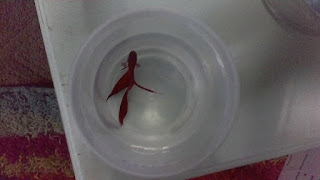
Important note:




Back to Cup Sickness
There's four main things that can cause these symptoms. At least three of these causes are usually present in cases of cup sickness.
1) High Ammonia Levels: Betta fish have a very high tolerance for ammonia. They can stay alive in cups with 32ppm of ammonia or higher in them. 1ppm of ammonia is considered the lethal level for ornamental fish, because living in 1ppm of ammonia for 4 days kills 50% of fish. Betta fish can stay alive in higher levels of ammonia, but they do start getting physical damage from it. Living in 4ppm of ammonia is just living in and breathing poison.
2) Small, Cold Living Space: If their bowl is a size of shape where they can't even swim their body length in a straight line, they are going to develop weird muscles. If there's no stimulation in their bowl, they're going to get bored and sit on the bottom. Cold water also makes them sleepy, contributing to cold. Water that is too cold also makes it harder for their digestive system to work properly. The combination of these things means that many fish get seriously overweight, and if they stay in the cup for longer they start losing all their muscles. They become extremely thin and very small.
3) Awful Food: Most betta foods on the market are just kind of crap. Betta fish cannot digest plant matter at all, but a lot of betta foods have grains in them as binders or fillers. Constantly needing to crap out over half the food they eat, combined with the fact that they can't move enough (moving aids in digestion) is just a recipe for serious constipation.
4) Damaged Slime Coat: Betta fish have a mucus-like coating on them, which their bodies make to protect them from physical damage and illnesses. Their slime coat can be damaged if they're sick, but it can also be damaged when they move or are touched too roughly. A lot of store carrying betta in cups don't have the time or skill to make sure the fish are not stressed or roughly handled every time the water in the cups is changed. Children of shoppers like to pick up fish cups and shake them (AND IF I CATCH YOUR KIDS DOING THAT I WILL GIVE YOU A PIECE OF MY MIND) This means that even if the cups are changed two or three times a week to keep the ammonia levels lower, the fish are still being damaged.
Usually, Cup Sickness is caused by 1, 2, and 3, with an occasional appearance by 4. So, your fish has cup sickness, or you bought a fish with cup sickness, or your friend was going to get rid of their fish because it started swimming sideways...whatever it is, you have a sick fish on your hands.
A lot of people are going to tell you that you need to feed a pea to the fish and they'll be fine, bathe them in Epsom salts, blah, blah.
Adding aquarium salt to the water of a bloated fish will make the bloating worse. Throwing that out there.
So, let's go over the basics of treating a sick fish really fast:
First of all, betta fish are small and the wrong treatment can take a very serious toll on their bodies. You don't want to give a fish antibiotics if you're not 100% sure they need them, because they can stress the poor fish's kidneys. A bath in Epsom salts can also stress out their kidneys and their respiratory system, which will already be damaged if they are living in a high-ammonia environment. You don't want to put anything in their digestive tract that can damage it unless you know it is necessary. Unless you are very sure than the betta's condition is rapidly deteriorating, you want to use the smallest and least damaging treatments possible, working your way up until you find the most gentle treatment that works.
So, the first thing that causes cup sickness is ammonia levels, and the first treatment is to get them out of high ammonia water. This means getting them into a larger tank or tub.
 This is how most of my hospital tanks for sick fish look. The plastic is easy to clean, and cheap enough that if a fish had something really contagious I can just never use it for fish again. Having no substrate makes it easier to monitor a fish's digestion (counting the poops). They have something in the tank that they can use for hiding and to not feel so exposed. They have heaters keeping the water at 75-83. Both of these tubs have about 3 gallons of water in them, and no filters.
Unless you have a filter already cycled* that has a very low output, I don't filter hospital tanks for cup sickness. When the fish is trapped at the surface, small bubbles will move them constantly.
Getting them into ammonia-free water is the first step. The next step is to make sure that their water is a good temperature. Get a heater that you can control the heat on, and that has an internal thermostat. Set it to the higher range of their acceptable water levels (I like 80).
Instead of putting 80 degree water in the tank, I try to match the temperature of the cup the fish is in. I then add the fish before I turn the heater on. This changes the temperature of their water much more slowly.
So, they're in ammonia-free water that is heated, and at least three times as long as the fish's body so they can swim. What now?
Now you just wait. Unless you /know/ the fish has not eaten in the past week, don't feed him. Don't put peas in there, don't bathe him or add salt or anything. Put him in good, clean water, heat it to the right temperature, and let him be for a day. Keep checking on him, make sure he's not panting or deteriorating, but just give him space and clean water and give that a chance to do its thing.
In some more mild cases, enough water is all you need.

Sometimes, though, water isn't all you need.
Once the fish has been in his new water for about twelve hours, it's time to feed him. Make sure that what you're feeding is good quality food. He's probably got all sorts of weird shit in his digestive tract from eating whatever Hikari shit the store's feeding him. I like to limit it to one or two pebbles (I feed Omega One, which has larger pebbles) and no more. Then it's a matter of waiting and counting if he poops.
This is why it's a good idea to not have gravel.
If it's been 24 hours and your fishy hasn't pooped, it's time to feed him something with fiber. A lot of people suggest a pea. Peas are entirely plant-based, so the betta cannot digest any of it. In theory, when he shits that fucker out, it'll take out anything else in his digestive system that might be blocking it.
To feed him a pea, take a frozen pea and microwave it for about 10 seconds. Then use your fingernail to pull off a section about the same size as a food pebble, and drop it in the tank. If your fish is aggressive, desperate, or kind of dumb, he might go right for it.
If you just can't get him to eat a pea (can you blame him?) go to the pet store and get frozen daphnia or frozen mysis shrimp.
Both of these are things a betta might naturally want to eat. Daphnia have a natural laxative effect and mysis shrimp have an exoskeleton that's all fiber. They're also much easier to feed than tricking him into eating a pea.
If you're on day three and the swelling just will not go down, then you can try to give him an epsom salt bath. I pull half a gallon of their tank water out into a pitcher, add two teaspoons of epsom salt and dissolve it. Then I transfer the fish into the pitcher and watch him like mad for ten minutes. If he starts panting or panicking, I immediately transfer him back. If he stays calm for all ten minutes, I transfer him back to his tank, and then add half a gallon of fresh water into his tank to replace what I pulled out of the tank.
Honestly, this has never failed me. In some cases it's taken weeks, weeks on constant ammonia checks and water changes and baths and poop counting, but all of my cup sickness rescues are now better and normal fish.
And it's worth it.
_____
*We haven't talked about cycling yet, but we will
My personal rule is that I'll never buy a sick betta fish from a store unless they give me a discount on the fish. I'll also never buy a fish that I know will die.
This sort of comes from where I used to work, when I was keeper of the betta.
Basically, stores understand money more than they understand morality. When you're buying something at full price, you're telling the store, "Yes, I like what you're doing, keep doing this," and telling them that sick fish will still sell. When you ask for a discount you're telling the store that the fish is not worth as much when it is sick. Stores do not want product that can only be sold at a discount
Buying a fish that you know is going to die is removing the responsibility of looking at the dead fish and disposing of the body from the store. Knowing that a fish died and looking at a dead fish are two different things.
This means that if a store won't give me a discount on a sick fish, I have to walk away. I have to leave that fish. It is not easy. It's never easy. But it has to be done, to teach the stores that their fish need to be taken care of.
I'm trying to find the video of Steve Irwin, the Crocodile Hunter, talking about buying illegal animals at a market. He's filming this video at a market in some country where people have taken wild animals, put them in tiny cages, and are selling them as novelties or pets or for their fur (I don't remember why). You can watch Steve's heart break as he's explaining that he has room for them at his zoo and he has enough money to buy all of them and give them a home, but for every animal he buys, another one is caught and put in its place in the market. I know that Steve Irwin loved animals more than I am capable of loving anything, and if he could walk away from those animals, I can walk away from a betta at Petco.
This doesn't mean that you should only buy betta fish in perfect health. A little fin rot or a little skinniness is normal from a fish that's been living in 1/18th of a gallon for more than a couple weeks. It does mean, however, that you should consider the quality of life of all the fish in the store before you buy an extremely sick fish.
Soapbox done.
I'm going to call this Cup Sickness. A lot of fish who stay on the shelves at the store, or who live in enclosures too small (LOOKIN' AT YOU, BETTA CUBES, FUCK YOU, BETTA CUBES) get this combination of problems.
~They lose the ability to control how they float. This usually means they're stuck on their sides at the surface of the water, but sometimes means they can't float and are stuck at the floor of their cups. Losing their ability to control their floating is called swim bladder disease, or SBD
~They become either extremely skinny or seriously overweight (or both, which, yes, is possible). A betta's weight is easiest to see when viewed directly from above.
~They often have very poor muscle tone, from not being able to swim in a straight line
~They are often constipated, and may have a swollen tummy.
Important note:

Cup Sickness

Cup Sickness

Cup Sickness

Cup Sickness
BUT THIS


IS NOT CUP SICKNESS
This is called Mystery Bloat or Malwai Bloat. This fish was not having trouble floating or sinking. He's severely swollen in all directions, like he swallowed a marble. His scales are sticking up. This is not cup sickness. Mystery/Malwai bloat is contagious and fatal for betta fish. Do not bring a fish with this sickness into your house.
Back to Cup Sickness
There's four main things that can cause these symptoms. At least three of these causes are usually present in cases of cup sickness.
1) High Ammonia Levels: Betta fish have a very high tolerance for ammonia. They can stay alive in cups with 32ppm of ammonia or higher in them. 1ppm of ammonia is considered the lethal level for ornamental fish, because living in 1ppm of ammonia for 4 days kills 50% of fish. Betta fish can stay alive in higher levels of ammonia, but they do start getting physical damage from it. Living in 4ppm of ammonia is just living in and breathing poison.
2) Small, Cold Living Space: If their bowl is a size of shape where they can't even swim their body length in a straight line, they are going to develop weird muscles. If there's no stimulation in their bowl, they're going to get bored and sit on the bottom. Cold water also makes them sleepy, contributing to cold. Water that is too cold also makes it harder for their digestive system to work properly. The combination of these things means that many fish get seriously overweight, and if they stay in the cup for longer they start losing all their muscles. They become extremely thin and very small.
3) Awful Food: Most betta foods on the market are just kind of crap. Betta fish cannot digest plant matter at all, but a lot of betta foods have grains in them as binders or fillers. Constantly needing to crap out over half the food they eat, combined with the fact that they can't move enough (moving aids in digestion) is just a recipe for serious constipation.
4) Damaged Slime Coat: Betta fish have a mucus-like coating on them, which their bodies make to protect them from physical damage and illnesses. Their slime coat can be damaged if they're sick, but it can also be damaged when they move or are touched too roughly. A lot of store carrying betta in cups don't have the time or skill to make sure the fish are not stressed or roughly handled every time the water in the cups is changed. Children of shoppers like to pick up fish cups and shake them (AND IF I CATCH YOUR KIDS DOING THAT I WILL GIVE YOU A PIECE OF MY MIND) This means that even if the cups are changed two or three times a week to keep the ammonia levels lower, the fish are still being damaged.
Usually, Cup Sickness is caused by 1, 2, and 3, with an occasional appearance by 4. So, your fish has cup sickness, or you bought a fish with cup sickness, or your friend was going to get rid of their fish because it started swimming sideways...whatever it is, you have a sick fish on your hands.
A lot of people are going to tell you that you need to feed a pea to the fish and they'll be fine, bathe them in Epsom salts, blah, blah.
Adding aquarium salt to the water of a bloated fish will make the bloating worse. Throwing that out there.
So, let's go over the basics of treating a sick fish really fast:
First of all, betta fish are small and the wrong treatment can take a very serious toll on their bodies. You don't want to give a fish antibiotics if you're not 100% sure they need them, because they can stress the poor fish's kidneys. A bath in Epsom salts can also stress out their kidneys and their respiratory system, which will already be damaged if they are living in a high-ammonia environment. You don't want to put anything in their digestive tract that can damage it unless you know it is necessary. Unless you are very sure than the betta's condition is rapidly deteriorating, you want to use the smallest and least damaging treatments possible, working your way up until you find the most gentle treatment that works.
So, the first thing that causes cup sickness is ammonia levels, and the first treatment is to get them out of high ammonia water. This means getting them into a larger tank or tub.

Unless you have a filter already cycled* that has a very low output, I don't filter hospital tanks for cup sickness. When the fish is trapped at the surface, small bubbles will move them constantly.
Getting them into ammonia-free water is the first step. The next step is to make sure that their water is a good temperature. Get a heater that you can control the heat on, and that has an internal thermostat. Set it to the higher range of their acceptable water levels (I like 80).
Instead of putting 80 degree water in the tank, I try to match the temperature of the cup the fish is in. I then add the fish before I turn the heater on. This changes the temperature of their water much more slowly.
So, they're in ammonia-free water that is heated, and at least three times as long as the fish's body so they can swim. What now?
Now you just wait. Unless you /know/ the fish has not eaten in the past week, don't feed him. Don't put peas in there, don't bathe him or add salt or anything. Put him in good, clean water, heat it to the right temperature, and let him be for a day. Keep checking on him, make sure he's not panting or deteriorating, but just give him space and clean water and give that a chance to do its thing.
In some more mild cases, enough water is all you need.

This is Cinco. Cinco had been in a cup at work, stuck on the bottom and unable to reach the surface without fighting, for five months. Where his swim bladder was, the side of his body had caved in. I thought he had a birth defect and that he would never be able to swim.
Brought him home and put him in a bowl I'd carefully built to accommodate a betta who can't float. Went to sleep, woke up, and he could swim fine. He's still very sensitive to water currents and ammonia levels, but for the majority of the time he swims like a normal fish.
Sometimes, though, water isn't all you need.
Once the fish has been in his new water for about twelve hours, it's time to feed him. Make sure that what you're feeding is good quality food. He's probably got all sorts of weird shit in his digestive tract from eating whatever Hikari shit the store's feeding him. I like to limit it to one or two pebbles (I feed Omega One, which has larger pebbles) and no more. Then it's a matter of waiting and counting if he poops.
This is why it's a good idea to not have gravel.
If it's been 24 hours and your fishy hasn't pooped, it's time to feed him something with fiber. A lot of people suggest a pea. Peas are entirely plant-based, so the betta cannot digest any of it. In theory, when he shits that fucker out, it'll take out anything else in his digestive system that might be blocking it.
To feed him a pea, take a frozen pea and microwave it for about 10 seconds. Then use your fingernail to pull off a section about the same size as a food pebble, and drop it in the tank. If your fish is aggressive, desperate, or kind of dumb, he might go right for it.
If you just can't get him to eat a pea (can you blame him?) go to the pet store and get frozen daphnia or frozen mysis shrimp.
Both of these are things a betta might naturally want to eat. Daphnia have a natural laxative effect and mysis shrimp have an exoskeleton that's all fiber. They're also much easier to feed than tricking him into eating a pea.
If you're on day three and the swelling just will not go down, then you can try to give him an epsom salt bath. I pull half a gallon of their tank water out into a pitcher, add two teaspoons of epsom salt and dissolve it. Then I transfer the fish into the pitcher and watch him like mad for ten minutes. If he starts panting or panicking, I immediately transfer him back. If he stays calm for all ten minutes, I transfer him back to his tank, and then add half a gallon of fresh water into his tank to replace what I pulled out of the tank.
Honestly, this has never failed me. In some cases it's taken weeks, weeks on constant ammonia checks and water changes and baths and poop counting, but all of my cup sickness rescues are now better and normal fish.
And it's worth it.
_____
*We haven't talked about cycling yet, but we will
Wednesday, May 18, 2016
Betta Care: Let's talk decor
Decor is all the stuff in your tank that's not water or your fish.
You have decor for two reasons: 1) To make the tank pretty and something you like having in your house, 2) To replicate the natural environment of your fish.
This means you have three things to keep in mind when you're decorating (aquascaping) your tank: 1) Will it make my betta feel safe, 2) Do I like how it looks, and 3) Will it hurt my fish?
Pshaw, Polly, I'm not just sticking random shit in my tank. I got it from the pet store! I don't need to worry about if it'll hurt my fish.
Bad news, Italicized Strawman. A lot of decor you can get at the pet store will hurt your fish. Some stores sell cheap (or overpriced) decor that has paint that'll flake off into the water. Also, betta fish have very delicate fins. Sharp or rough decor can rip right through them.

The sand, gravel, or stones you put on the bottom of your tank is called substrate. There's several different kinds, all with good and bad sides.
 I like gravel. It comes in a lot of colors, it's cheap, I find it easy to clean, and it's reusable. It's the only substrate you can use with an undergravel filter. I suggest getting about 1 pound a gallon for your tank (though this depends on the shape of the tank).
Some people don't like gravel because it requires a more thorough vacuuming than sand does. You can't grow live plants in gravel, and it's dangerous for bottom feeders like catfish to be on. (side note, don't put gravel in your goldfish tank. They try to eat it and frequently choke).
The cup on the right in the above picture has glass stones. Large acrylic or glass stones are great for unfiltered tanks. They're easy to dump out, rinse off, and put back in the bowl. You don't need to worry about them going down your sink like you have to worry about gravel.
Some people use very large stones, 3"+, in their aquariums. This works really well for goldfish, but betta will try to swim through any little hole, and can get caught. If you use large stones, make sure they are smooth and that there are no spaces a fish could get stuck.

When you're buying sand, make sure you're not getting marine sand. Marine sand has salt in it and isn't good for betta tanks. Play sand and pool filter sand both work for fish.
Sand is difficult to remove, and if you frequently rescape your tanks it is also very difficult to clean up and move. It's easier to bury plants in. You can't use it with a buried heater and you can't use it with an undergravel filter. It doesn't come in any fun colors.
Some people have an easier time cleaning sand than gravel, or feel they do a more thorough job cleaning it. A lot of people like that it's more natural looking. People who have tanks with live plants like sand for planting in it.

You can also choose to have no substrate and just have a bare tank floor. I like this because it makes it easy to tell if the tank is clean and very easy to vacuum, but it's harder to add more water without the decor sliding around.
It's also important to remember that if you're going to divide a tank, you need at least an inch of substrate to bury the bottom of the divider.
Now, other stuff!
 I suggest that every betta enclosure has some kind of cave. A cave is anything a fish can swim into and hide. You can buy cool ones that look like pirate ships or skulls, or you can use a mug or teacup or terra cotta flowerpot turned on its side (no metallic decorations, though, as those can be toxic).
 I call these guys ornaments. They're hard decor that isn't meant to look like plants. When Twister had the triangular arch in his tank, he liked swimming through it. It's possible to put an airstone under the lighthouse and have bubbles come out the window, which is pretty cool looking.

 Before we go on, there's two types of bases for plant decoration. Bottom left is my favorite, the weighted base. You can bury the end in gravel or sand, or have it just sit on the floor of the tank. I like these because if I accidentally unbury one, it doesn't float to the roof of the tank.
The top and bottom right ones have cups in the bottom that you have to bury to make it stay down. If you have sand, these stay better than if you have gravel. They do not work at all for bare tanks.
Now, on to plants:

Silk plants (which are made from fabric, but not necessarily silk) are my favorite for betta fish. They are soft and don't scratch delicate fins, and a lot of them have big leaves to sleep on.

 Here's some soft plastic plants. They don't have sharp edges. Even though some of them are made of hard plastic, they don't have bits that are easy to catch a fin on.
If you want to test if a plant is good for your betta tank, put on some tights and rub the plant on your thigh (or pretend you did). If it snags your pantyhose, it's too sharp.
 And here's the sharp plants that I suggest you avoid. If you grab one of these in your hand and squeeze, you can feel it digging into your hand.
 When you're actually scapeing your tank, put short plants at the front and tall plants at the back. Petsmart sells these filler carpets that are great for cutting up and adding little decorations. That's what that front piece is. Here Casper's got a clay pot for a cave.
 Mr Tipsy's cave is wider than his apartment, and has to be at an angle. Again, note the tall plants in the back and short in the front. This isn't for any health reason, it's just nicer looking in general.
 Bo's got a lovely piece of driftwood that I made sure was smooth before I put it in the tank. For the first few months, the driftwood turned the water brown and I had to use carbon in my filter to keep the color away. Now, however, it's done leaching tannin and just looks pretty. Driftwood can help lower your PH, and the tannins they stain the water with don't hurt your fish.
 And here's Twister's dragon. The dragon has an airstone in it to let it breathe bubbles, but I disabled it because Twister already had the UGF lift tube putting bubbles into his tank. Twister doesn't have a cave, and instead has a very dense group of tall and short plants in the back of his space. This is because when he had a cave, he'd still hide in the plants if he was scared, so it seemed better to replace the cave with more plants.
Well, that's more than anyone ever needed to know about fish tank decorations. Have fun, folks.
You have decor for two reasons: 1) To make the tank pretty and something you like having in your house, 2) To replicate the natural environment of your fish.
This means you have three things to keep in mind when you're decorating (aquascaping) your tank: 1) Will it make my betta feel safe, 2) Do I like how it looks, and 3) Will it hurt my fish?
Pshaw, Polly, I'm not just sticking random shit in my tank. I got it from the pet store! I don't need to worry about if it'll hurt my fish.
Bad news, Italicized Strawman. A lot of decor you can get at the pet store will hurt your fish. Some stores sell cheap (or overpriced) decor that has paint that'll flake off into the water. Also, betta fish have very delicate fins. Sharp or rough decor can rip right through them.

This is just the stuff that's not currently being used
Luckily, I have a lot of decor hanging around, so I can talk about the good and the bad.The sand, gravel, or stones you put on the bottom of your tank is called substrate. There's several different kinds, all with good and bad sides.

Some people don't like gravel because it requires a more thorough vacuuming than sand does. You can't grow live plants in gravel, and it's dangerous for bottom feeders like catfish to be on. (side note, don't put gravel in your goldfish tank. They try to eat it and frequently choke).
The cup on the right in the above picture has glass stones. Large acrylic or glass stones are great for unfiltered tanks. They're easy to dump out, rinse off, and put back in the bowl. You don't need to worry about them going down your sink like you have to worry about gravel.
Some people use very large stones, 3"+, in their aquariums. This works really well for goldfish, but betta will try to swim through any little hole, and can get caught. If you use large stones, make sure they are smooth and that there are no spaces a fish could get stuck.

2.5gal tank with sand
Sand is another popular substrate. You can buy a bag of play sand at the hardware store for $4 for 20 pounds, which will be enough for most tanks.When you're buying sand, make sure you're not getting marine sand. Marine sand has salt in it and isn't good for betta tanks. Play sand and pool filter sand both work for fish.
Sand is difficult to remove, and if you frequently rescape your tanks it is also very difficult to clean up and move. It's easier to bury plants in. You can't use it with a buried heater and you can't use it with an undergravel filter. It doesn't come in any fun colors.
Some people have an easier time cleaning sand than gravel, or feel they do a more thorough job cleaning it. A lot of people like that it's more natural looking. People who have tanks with live plants like sand for planting in it.
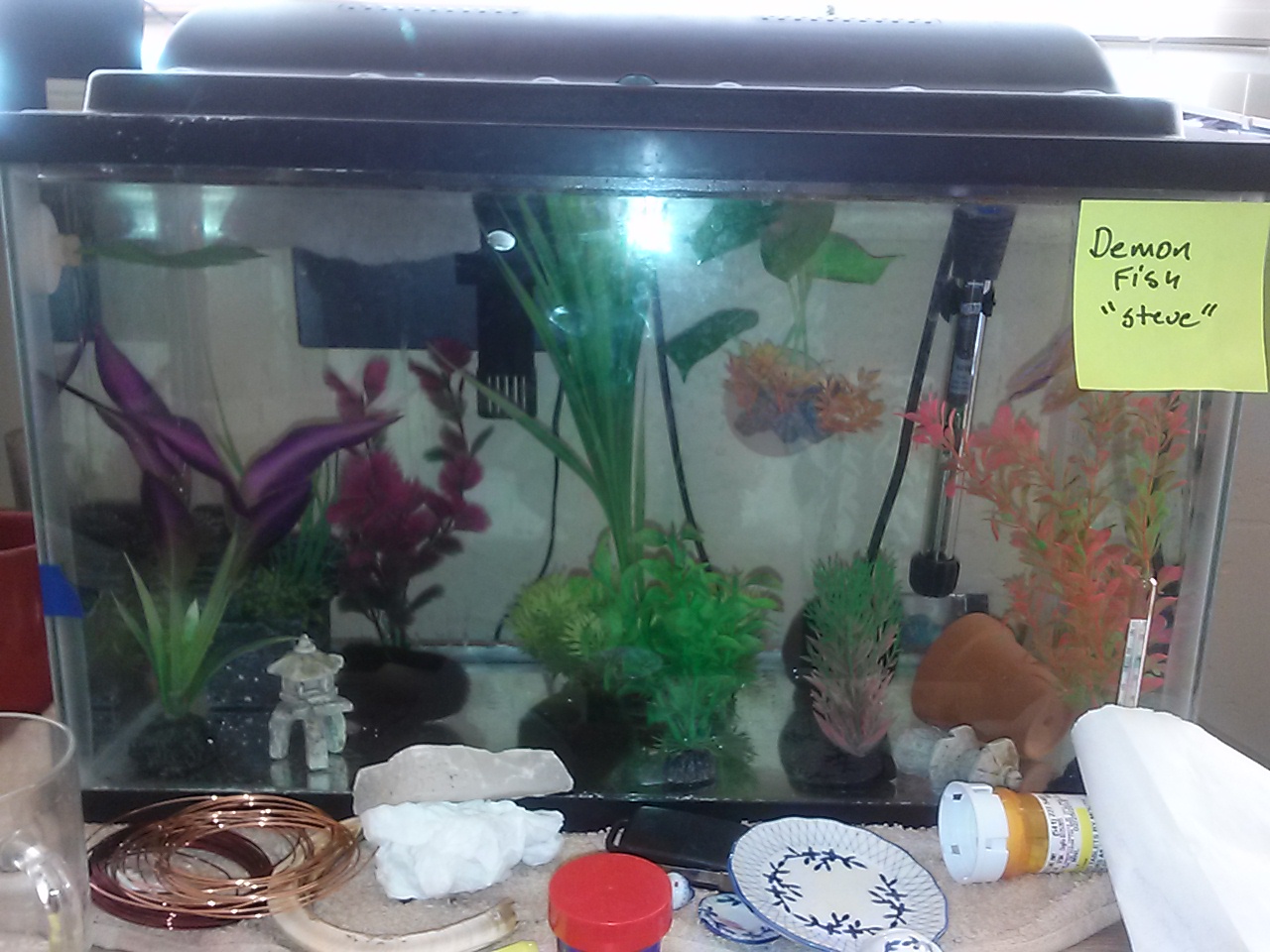
You can also choose to have no substrate and just have a bare tank floor. I like this because it makes it easy to tell if the tank is clean and very easy to vacuum, but it's harder to add more water without the decor sliding around.
It's also important to remember that if you're going to divide a tank, you need at least an inch of substrate to bury the bottom of the divider.
Now, other stuff!


DON'T TOUCH MY LEEF!!!!!
Here's some betta-specific decor. The left is a betta log, and the right are betta leaf hammocks. If you have an older fish or a fish you've noticed sleeping on other things in the tank, it can be nice to give them a leaf that's meant specifically for sleeping on, or a log for sleeping in. Currently, none of my tanks have betta leafs or betta logs.
The top and bottom right ones have cups in the bottom that you have to bury to make it stay down. If you have sand, these stay better than if you have gravel. They do not work at all for bare tanks.
Now, on to plants:

Silk plants (which are made from fabric, but not necessarily silk) are my favorite for betta fish. They are soft and don't scratch delicate fins, and a lot of them have big leaves to sleep on.


If you want to test if a plant is good for your betta tank, put on some tights and rub the plant on your thigh (or pretend you did). If it snags your pantyhose, it's too sharp.


Well, that's more than anyone ever needed to know about fish tank decorations. Have fun, folks.
Betta Care: A tank divided
In the last post that I wrote six minutes ago, I covered two things: you cannot (in general) keep betta fish together, and you have to be very careful when keeping betta fish with other fish.
So what if you want nine betta fish but you don't want to change nine tanks, and buy nine filters and nine heaters.
Some people really hate split tanks, but I love them.
The dangers of split tanks: fish getting around or over the dividers and hurting each other, diseases traveling through shared water, betta seeing each other and being constantly stressed.
The advantages of split tanks: fewer filters, fewer heaters, fewer water changes, fewer lights. Easier to keep parameters stable for several fish, fewer water tests, less space. A larger water quantity makes waste build up more slowly.
So, first of all, what's a good divided tank?


There are two dangers that you find in divided tanks that you don't find in solo tanks. The first is that if your betta fish somehow gets around or over the divider, there's a good chance that he'll kill his tank-mate. The other concern is that if one fish in a divided tank gets sick, every fish gets exposed to it. Instead of losing one fish, you can lose several. If one heater fails, all your fish will be too cold. You're putting all your eggs in one basket.
Both of these are 100% avoidable, however. Proper quarantining is an important part of any shared tank. Quarantining means you keep the new fish in his own tank for ~30 days, to make sure he doesn't have any disease that could spread. Proper care for a community tank means not putting in any fish you know is sick, or you know was exposed to a disease.

First, you need to think about how big of a tank you want. I recommend having at least 4 gallons of water per fish. This is based on the total water volume. The tank might be divided, but they'll all be breathing the same water, so you need to have enough of that. The other concern is space. Take a very critical look at the size that each apartment will be when it's divided. It needs to be deep enough, wide enough, and tall enough. For this reason I say that a 20-long tank can be divided into four, but a 20-high tank should only be divided into two.
Also you need to take into account your fish. If you have a big guy, he might not be comfortable in 1/4 of a 20-long, but other fish will have plenty of space. If you have a very aggressive fish that will spend hours trying to attack the shadow on the other side of the divider, he might not be happy in a divided tank. Just because a stranger on the internet said it'd be okay for most fish doesn't mean it'll be good for every fish.
I make mine out of plastic needlepoint canvas, the spines to report covers, and a shitload of aquarium silicone. You cut the canvas to the shape you need, put two or three layers together. Then you snap one report spine on the top, and silicone two more spines into the tank. Then you slide the canvas into the spines, and cover the bottom of the divider with gravel or sand. There's tutorials out there that go over this exact process.

Using silicone to attach the dividers to the walls of the tank is very important. Betta are crafty little fuckers and they can find their way through the gaps in the wall. It's very important that you also use aquarium silicone. The bottle just saying 100% silicone isn't good enough. Go to the hardware store, find an employee, and ask for aquarium-safe silicone. Then make sure it says "aquarium safe" on the packaging. If they don't have it, buy it online. A lot of silicones that you can find in the hardware store have anitfungal additives that will kill your fish. This is a case where buying the wrong product will kill your fish, so be careful.
If there won't be a lot of jump space when your tank hood is closed, you only need one divider. If there will be a lot of space, you can use two dividers with a little space to catch an angry jumper.

If you have a jump space, you can keep your heater or your HOB intake in the jump space, to leave you with more space in the living space.
If you want to temporarily un-divide your tank, you can slide the needlepoint canvas out and leave the spines glued in. This will let you re-divide it without having to drain the tank and glue in new spines. If you decide that you want to un-divide it long term, you can remove the silicone cleanly with a razor.
As a final note, I've been told that you should not keep a male and female betta in a divided tank, because being close to each other will keep them constantly ready to breed and stress them out. I have never tested this, but if you are interested in keeping a boy and a girl in the same divided tank, this is something you should research first.
And remember that a healthy fish is prettier than the prettiest tank in the world!
So what if you want nine betta fish but you don't want to change nine tanks, and buy nine filters and nine heaters.
Some people really hate split tanks, but I love them.
The dangers of split tanks: fish getting around or over the dividers and hurting each other, diseases traveling through shared water, betta seeing each other and being constantly stressed.
The advantages of split tanks: fewer filters, fewer heaters, fewer water changes, fewer lights. Easier to keep parameters stable for several fish, fewer water tests, less space. A larger water quantity makes waste build up more slowly.
So, first of all, what's a good divided tank?

Here's a hint, it's not this thing.
A divided tank is a tank that has a barrier in it to keep the fish apart. The fish all live in the same tank, and that tank only requires the maintenance of one tank, but can have more than one living space in it.

10 gallon tank, divided to have two living spaces and a small space in the middle.
There are two dangers that you find in divided tanks that you don't find in solo tanks. The first is that if your betta fish somehow gets around or over the divider, there's a good chance that he'll kill his tank-mate. The other concern is that if one fish in a divided tank gets sick, every fish gets exposed to it. Instead of losing one fish, you can lose several. If one heater fails, all your fish will be too cold. You're putting all your eggs in one basket.
Both of these are 100% avoidable, however. Proper quarantining is an important part of any shared tank. Quarantining means you keep the new fish in his own tank for ~30 days, to make sure he doesn't have any disease that could spread. Proper care for a community tank means not putting in any fish you know is sick, or you know was exposed to a disease.
You can keep bettas on their side of their dividers by building the dividers properly. The dividers you see at the pet store don't work for betta fish. Those dividers are built for fish who don't have the biological desire to murder everything they see. The good news is that you can easily build the kind of divider that does work for betta fish, and they're cheaper than the ones at the pet store.

A 20 gallon long tank divided 4-ways
First, you need to think about how big of a tank you want. I recommend having at least 4 gallons of water per fish. This is based on the total water volume. The tank might be divided, but they'll all be breathing the same water, so you need to have enough of that. The other concern is space. Take a very critical look at the size that each apartment will be when it's divided. It needs to be deep enough, wide enough, and tall enough. For this reason I say that a 20-long tank can be divided into four, but a 20-high tank should only be divided into two.
Also you need to take into account your fish. If you have a big guy, he might not be comfortable in 1/4 of a 20-long, but other fish will have plenty of space. If you have a very aggressive fish that will spend hours trying to attack the shadow on the other side of the divider, he might not be happy in a divided tank. Just because a stranger on the internet said it'd be okay for most fish doesn't mean it'll be good for every fish.
I make mine out of plastic needlepoint canvas, the spines to report covers, and a shitload of aquarium silicone. You cut the canvas to the shape you need, put two or three layers together. Then you snap one report spine on the top, and silicone two more spines into the tank. Then you slide the canvas into the spines, and cover the bottom of the divider with gravel or sand. There's tutorials out there that go over this exact process.

Center two apartments of the divided 20. The left and right walls are needlepoint canvas dividers
Using silicone to attach the dividers to the walls of the tank is very important. Betta are crafty little fuckers and they can find their way through the gaps in the wall. It's very important that you also use aquarium silicone. The bottle just saying 100% silicone isn't good enough. Go to the hardware store, find an employee, and ask for aquarium-safe silicone. Then make sure it says "aquarium safe" on the packaging. If they don't have it, buy it online. A lot of silicones that you can find in the hardware store have anitfungal additives that will kill your fish. This is a case where buying the wrong product will kill your fish, so be careful.
If there won't be a lot of jump space when your tank hood is closed, you only need one divider. If there will be a lot of space, you can use two dividers with a little space to catch an angry jumper.

Divided 10 with a thermometer in the jump space
If you want to temporarily un-divide your tank, you can slide the needlepoint canvas out and leave the spines glued in. This will let you re-divide it without having to drain the tank and glue in new spines. If you decide that you want to un-divide it long term, you can remove the silicone cleanly with a razor.
As a final note, I've been told that you should not keep a male and female betta in a divided tank, because being close to each other will keep them constantly ready to breed and stress them out. I have never tested this, but if you are interested in keeping a boy and a girl in the same divided tank, this is something you should research first.
And remember that a healthy fish is prettier than the prettiest tank in the world!
Betta Care: Community Tanks
Lots of people say betta are solitary fish, and this is largely true.
Under no circumstances should you put multiple male betta in the same living space.
Under no circumstances should male and female betta live in the same space for long term.
Keeping females together requires very specific setup and some generally chill-headed (for betta) fish, and should only be done if you have experience with betta fish.
I'm going to repeat that in bold text to make sure you get it. Under no circumstances should a male betta fish live in the same living space as any other betta fish.
Betta fish do not like to live with each other.
Betta fish that live with each other frequently kill each other.
Got that?
On the other hand, betta fish can have tank-mates.
When you're looking for a tank-mate for your fish, you need to take into account both what your fish needs to be happy and healthy and what the other members of the tank need to be happy.
Full disclosure: I do not have experience keeping betta fish with other fish. Most of what I am sharing here is synthesis of other people's research and experience, and not my own research and experience. Before you put other animals with your betta fish, make sure you do your own research. I do not know your fish or your life and I cannot do your research for you.
Tank-made checklist:
Is my tank big enough? Just don't try to do a mixed-species community tank in a tank smaller than 10 gallons, and I suggest going bigger. There's several reasons why. First of all is the bio-load. All living animals that you might put in a tank produce waste. Your filter (and you need one for a community tank) takes that waste and makes it into less toxic nitrate, but nitrate is still toxic in large amounts, and you don't want it building up too fast. Apart from the nitrate, the waste your tank inhabitants produce creates solid waste on the floor of the tank and in the gravel. If you have too many inhabitants, these things will build up faster.
The other reason why you need a larger tank is that different species of fish (or other animals) do not always like living in close quarters with other species. Everyone needs room to have their own territory. Some species are also social (zebra danio) or schooling (cory catfish, tetras), and you need enough room for six or more of them.
In general, betta like to occupy the top 2/3rds of the tank, so they do better with animals that like to stay in the bottom part of the tanks. Because of this, I suggest going against danios (including their glofish cousins), who also like the top of the tank.
Are the living requirements the same? Betta fish need water that's 76F-82F. They need tanks with a decent amount of cover. They need to reach the surface to get air.
Therefore, if the tank-mates do not also do best with water in the 76-82 range, or if they need to not have dense planting, or if their other living requirements do not match the betta's requirements, you should not put them in the same tank. For this reason, I suggest against African Dwarf Frogs. They need cooler water.
Are they going to provoke the betta? Betta fish like to attack anything quick moving or brightly colored, or anything that shows it too much interest. For this reason, I do not recommend putting a betta with neon tetras, who are very bright. Glofish are out. Lyretail mollies have big fins that draw betta's attention.
Are they going to attack the betta? The answer to violence is not more violence. The answer to an aggressive fish is not another aggressive fish.
Betta tankmates that I've personally had good luck with: ghost shrimp (and I've heard that other nonaggresive shrimp like bamboo shrimp work very well, though cherry shrimp can become dinner if your fish is so inclined), pond snails and other snails that are small (including mystery snails and apple snails, if you have a backup plan for when they outgrow your betta tank), and marimo. Due to the extra stress of making sure that everyone in the tank gets along, and the fact that some days I work a lot of hours and don't get a chance to look at my tank beyond feeding everyone, I don't keep community betta tanks with other fish. I'd rather just have more betta fish. I do really like ghost shrimp with betta, though. They're exciting to watch and generally stay at the bottom of the tank. They're willing to defend themselves if the betta gets curious, but they rarely actually attack the betta. Marimo are not animals. They are balls of algae. However, you can give them a name and talk to them, and they never disagree with your betta. Marimo are the perfect pet.
Now you need to ask more questions:
How aggressive is your betta? Some betta fish are very aggressive, and some aren't as aggressive. If your betta flares at everything that goes past, he's probably not a good candidate for tank-mates.
If you are purchasing a betta specifically to put in a community tank, consider getting a female. While aggressive, the female betta are generally less aggressive than the males. While your fish (boy or girl) is in quarantine for 30 days (which you should do with every fish that you will put in a community tank), you'll get to know them and their aggression levels. If you buy a betta to put in a community tank, be ready to give them their own environment or rehome them if it is clear that they are too aggressive for the community tank.
But what about sorority tanks?!
Lots of people like to crap on sorority tanks, but I have seen them done well. A sorority tank is a large (20long or larger), very densely planted tank, with at least six female betta in it. Once you establish the tank, the girls will establish a pecking order and territories, and stop trying to kill each other. It's very important in a sorority tank to carefully monitor it for stress or bullies, and to be ready to have a place to have an overly-aggresive stay in a solo tank (or ready to be rehomed), in case things don't work out.
I do not suggest a sorority for a first tank. I think you need experience learning how to identify healthy fish and stressed fish and sick fish before you try something this complicated.
In fact, I do not suggest a community tank with betta and other fish as your first tank. In a community tank, you need to know what it looks like when your fish are hungry or sick or stressed. You need to know how to be in tune with how your fish is feeling, before setting up an environment where that is likely.
Remember, when you're an aquarium owner, keeping the fish healthy and happy, and meeting their needs, is much more important than what you think will look good. You are in charge of their entire ecosystem, and you owe it to them to have it be a safe and healthy one. If you want fish that will do whatever you want, that you can look at without needing to worry if they'll fight or become stressed, well, there's a lot of iPad apps for that that you might want to check out instead of hurting real fish.
Under no circumstances should you put multiple male betta in the same living space.
Under no circumstances should male and female betta live in the same space for long term.
Keeping females together requires very specific setup and some generally chill-headed (for betta) fish, and should only be done if you have experience with betta fish.
I'm going to repeat that in bold text to make sure you get it. Under no circumstances should a male betta fish live in the same living space as any other betta fish.
Betta fish do not like to live with each other.
Betta fish that live with each other frequently kill each other.
Got that?
On the other hand, betta fish can have tank-mates.
When you're looking for a tank-mate for your fish, you need to take into account both what your fish needs to be happy and healthy and what the other members of the tank need to be happy.
Full disclosure: I do not have experience keeping betta fish with other fish. Most of what I am sharing here is synthesis of other people's research and experience, and not my own research and experience. Before you put other animals with your betta fish, make sure you do your own research. I do not know your fish or your life and I cannot do your research for you.
Tank-made checklist:
Is my tank big enough? Just don't try to do a mixed-species community tank in a tank smaller than 10 gallons, and I suggest going bigger. There's several reasons why. First of all is the bio-load. All living animals that you might put in a tank produce waste. Your filter (and you need one for a community tank) takes that waste and makes it into less toxic nitrate, but nitrate is still toxic in large amounts, and you don't want it building up too fast. Apart from the nitrate, the waste your tank inhabitants produce creates solid waste on the floor of the tank and in the gravel. If you have too many inhabitants, these things will build up faster.
The other reason why you need a larger tank is that different species of fish (or other animals) do not always like living in close quarters with other species. Everyone needs room to have their own territory. Some species are also social (zebra danio) or schooling (cory catfish, tetras), and you need enough room for six or more of them.
In general, betta like to occupy the top 2/3rds of the tank, so they do better with animals that like to stay in the bottom part of the tanks. Because of this, I suggest going against danios (including their glofish cousins), who also like the top of the tank.
Are the living requirements the same? Betta fish need water that's 76F-82F. They need tanks with a decent amount of cover. They need to reach the surface to get air.
Therefore, if the tank-mates do not also do best with water in the 76-82 range, or if they need to not have dense planting, or if their other living requirements do not match the betta's requirements, you should not put them in the same tank. For this reason, I suggest against African Dwarf Frogs. They need cooler water.
Are they going to provoke the betta? Betta fish like to attack anything quick moving or brightly colored, or anything that shows it too much interest. For this reason, I do not recommend putting a betta with neon tetras, who are very bright. Glofish are out. Lyretail mollies have big fins that draw betta's attention.
Are they going to attack the betta? The answer to violence is not more violence. The answer to an aggressive fish is not another aggressive fish.
Betta tankmates that I've personally had good luck with: ghost shrimp (and I've heard that other nonaggresive shrimp like bamboo shrimp work very well, though cherry shrimp can become dinner if your fish is so inclined), pond snails and other snails that are small (including mystery snails and apple snails, if you have a backup plan for when they outgrow your betta tank), and marimo. Due to the extra stress of making sure that everyone in the tank gets along, and the fact that some days I work a lot of hours and don't get a chance to look at my tank beyond feeding everyone, I don't keep community betta tanks with other fish. I'd rather just have more betta fish. I do really like ghost shrimp with betta, though. They're exciting to watch and generally stay at the bottom of the tank. They're willing to defend themselves if the betta gets curious, but they rarely actually attack the betta. Marimo are not animals. They are balls of algae. However, you can give them a name and talk to them, and they never disagree with your betta. Marimo are the perfect pet.
Now you need to ask more questions:
How aggressive is your betta? Some betta fish are very aggressive, and some aren't as aggressive. If your betta flares at everything that goes past, he's probably not a good candidate for tank-mates.
If you are purchasing a betta specifically to put in a community tank, consider getting a female. While aggressive, the female betta are generally less aggressive than the males. While your fish (boy or girl) is in quarantine for 30 days (which you should do with every fish that you will put in a community tank), you'll get to know them and their aggression levels. If you buy a betta to put in a community tank, be ready to give them their own environment or rehome them if it is clear that they are too aggressive for the community tank.
But what about sorority tanks?!
Lots of people like to crap on sorority tanks, but I have seen them done well. A sorority tank is a large (20long or larger), very densely planted tank, with at least six female betta in it. Once you establish the tank, the girls will establish a pecking order and territories, and stop trying to kill each other. It's very important in a sorority tank to carefully monitor it for stress or bullies, and to be ready to have a place to have an overly-aggresive stay in a solo tank (or ready to be rehomed), in case things don't work out.
I do not suggest a sorority for a first tank. I think you need experience learning how to identify healthy fish and stressed fish and sick fish before you try something this complicated.
In fact, I do not suggest a community tank with betta and other fish as your first tank. In a community tank, you need to know what it looks like when your fish are hungry or sick or stressed. You need to know how to be in tune with how your fish is feeling, before setting up an environment where that is likely.
Remember, when you're an aquarium owner, keeping the fish healthy and happy, and meeting their needs, is much more important than what you think will look good. You are in charge of their entire ecosystem, and you owe it to them to have it be a safe and healthy one. If you want fish that will do whatever you want, that you can look at without needing to worry if they'll fight or become stressed, well, there's a lot of iPad apps for that that you might want to check out instead of hurting real fish.
Subscribe to:
Posts (Atom)